
In the 19th century, the German Lied became a natural form of expression for women. The grand canvases of symphony and opera were mostly off limits to them, but songs, with their small forces, could be written and performed in the drawing room or the salon, in private spaces where women’s artistry was more accepted. Within these confines, composers such as Fanny Hensel, Clara Schumann, Josephine Lang, and Johanna Kinkel cultivated voices of striking individuality, achieving on a small scale what they could not accomplish with the monumental genres of the era.
Despite women’s intimate association with song, the song cycle – a monumental form of a miniature genre – remained largely out of reach. In a book about the song cycle Laura Tunbridge observes that while Lieder “provided a suitable vehicle for feminine musical skills within the home” and “were also considered an appropriate genre for female composers,” women “produced few song cycles” (50). Collections of Lieder by women were published with some frequency, and some of these bear signs of cyclicity; the distinction between cycles and collections, after all, is more a matter of degree than of kind.
Yet true song cycles by women were rare, especially before the latter part of the century, and the exceptions prove the rule. Clara Schumann and Robert Schumann collaborated on a cycle of twelve songs (Liebesfrühling), published in 1841 with both composers’ names but no indication of who composed which song (Clara wrote three of the twelve). Felix Mendelssohn and Fanny Hensel had also produced a song cycle together in 1830, with Felix composing nine of the songs and Fanny composing three, though only Felix’s name appeared on the publication. Their Zwölf Lieder was his opus 9.
That both cycles were joint efforts with men – and that the women’s contributions were minimized or concealed – shows how inaccessible the genre was to women at the time. While individual songs could flourish in the domestic sphere, cycles demanded a more expansive and public frame of presentation that clashed with prevailing ideas about women’s artistic limits. As a result, the very composers who helped define the expressive possibilities of the 19th-century Lied were rarely given the chance to shape the grandest form of the genre.
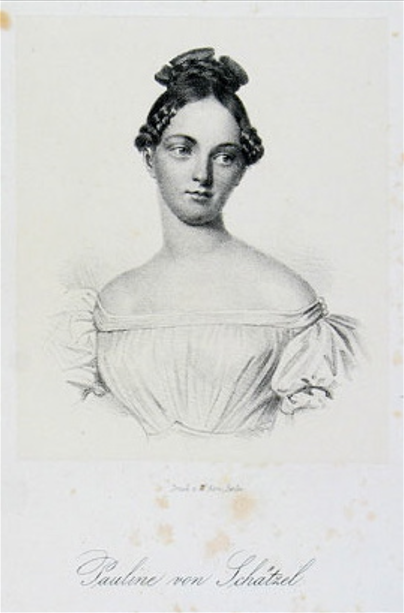
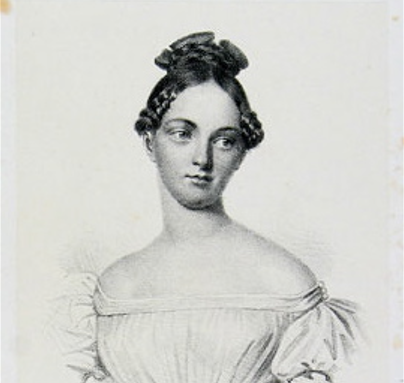
One such composer was Pauline Decker, née von Schätzel (1811–82), a celebrated German opera singer who in the latter years of her life published twenty-seven Lieder, which have gone largely unexplored. She published most of her songs individually and never wrote a song cycle. Decker came from a prominent musical family; she was the granddaughter of famed soprano Margarethe Luise Schick and the daughter of soprano Juliane von Schätzel. Trained in part by her mother, she began performing in concerts at the age of sixteen and then a year later made her operatic debut at the Königliche Oper in Berlin. She became one of the company’s leading sopranos, singing more than sixty roles. In 1832, however, her stage career ended when she married Rudolf von Decker, a royal court publisher. Yet she remained active in Berlin’s musical life: she participated regularly in the musical events that Fanny Hensel hosted on Sundays in her Berlin home and, starting in 1833, did performances in her own home, even including full operas.
Why Decker decided to publish several songs in her sixties we cannot know; perhaps it was to provide a record of her compositional efforts toward the end of her life, to demonstrate to posterity that she was not only a performer but also a composer. Her songs did attract the attention of critics, though the response was predictably dismissive of women’s compositional powers. A reviewer in the Allgemeine musikalische Zeiting described her songs as “quite fresh and charming,” though he concluded by questioning why women would compose in the first place. “The feminine nature,” he wrote, “is a receiving one, therefore more sympathetic than originally creative,” only capable of making “wonderful imitations” but not “original ore, from which one can strike the fire of the soul” (7).
Constructing a Cycle of Her Songs
Counteracting these views requires giving performers, scholars, and listeners access to Decker’s songs and presenting them in the most compelling way possible. That is what prompted me to create a cycle of eight Decker songs: I wanted to provide a vehicle for performers who would otherwise have to dig through archives and online databases to find her music. Yet I also wanted to provide Decker access to a genre that was unavailable to her, as it was to so many other women composers, using curation as a form of advocacy.
Creating a song cycle after the fact out of independent songs may sound anachronistic, but it was actually a common practice in the later 19th and early 20th centuries. Performers often assembled groups of songs from existing songs, sometimes even taking individual songs from larger cycles and mixing and matching them with other pieces. As Natasha Loges has noted:
The tendency to mix works and/or composers within a small group was widespread throughout the [second half of the 19th century] but seems to have become still more adventurous after 1900, especially in the golden age of the song recital. … Songs on related topics could be combined – for example, Schubert’s “Greisengesang” with “Der Doppelgänger” (from Schwanengesang) and the established favorite “Litanei.” Each group … would have been presented as a single “number” (of a total of between five and ten, on average), as a “Liederstrauss” or song bouquet (30–31).
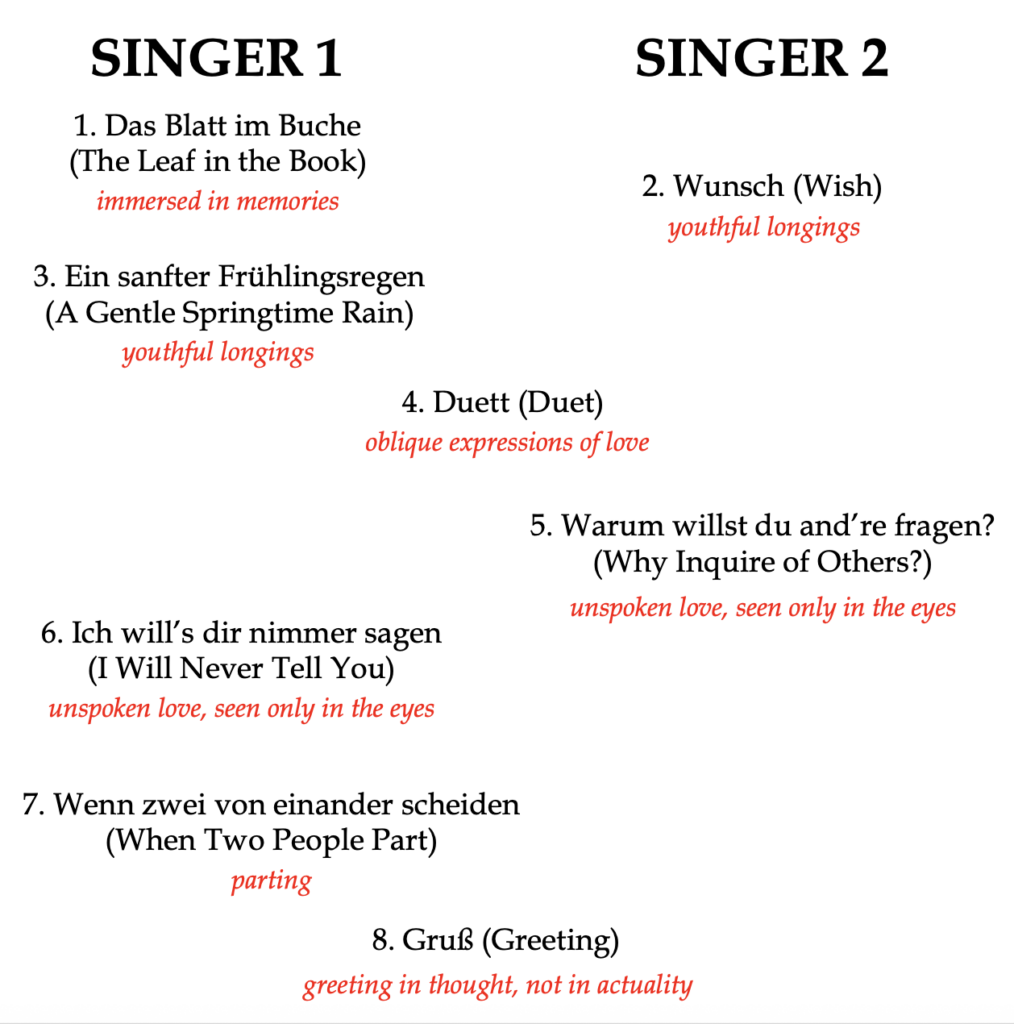
This particular Liederstrauss is a dialogue between two lovers (labeled singer 1 and singer 2 in the score) – but this is a dialogue less about confessions of love than about missed opportunities and unspoken feelings. (The cycle was published a couple of months ago by ClarNan Editions, a division of Classical Vocal Reprints.) It is a story of two people who love each other but can’t bring themselves to express it and therefore end up apart, looking back on a future that might have been.
The cycle begins with the image of an old woman who weeps while looking at a dried leaf pressed in a book, immersed in memories (song 1). The title of the cycle, Liebesblätter, picks up on the images in the first poem: the German word “Blätter,” like its English counterpart “leaves,” can refer either to leaves from a tree or to leaves from a book. The title could thus be translated as either “Love Leaves” or “Love Letters.” We then move to the past and the youthful longings expressed by both lovers (songs 2 and 3), and from there to a duet in which their confessions of love surface obliquely – through flowers, nightingales, and veiled glances (song 4). The lovers’ inability to speak their feelings becomes a theme that runs through the cycle (songs 5 and 6). Even in parting (song 7), they hide their grief, suppressing sighs and tears until after the farewell. The cycle ends after they have left one another, with another duet (song 8) filled with sadness but also with a promise to greet one another each day in thought if not in actuality.
Bringing the Cycle to Life
This fall I had the chance to perform the cycle, along with mezzo-soprano Naomi Castro and pianist Lindsey Rodgers. After the performance, I asked the crowd to tell me how they understood the story of the cycle. I was surprised by the number of different interpretations they offered. Some heard the two characters as young lovers – one person called it “Romeo and Juliet but with even poorer communication.” But others imagined that these might be an older couple, perhaps even people looking back on feelings that might have been expressed but now, so many years later, can’t be uttered. A woman came up to me afterwards and suggested an even more out-of-the-box reading: what if one of the characters in this love story has dementia? What if their inability to confess their love in words results not from emotional reluctance but from physical disability? This makes the lovers’ separation in the final song even more heartbreaking: they don’t leave one another; one person slowly recedes, unwillingly, from the other.
As if performing these songs myself wasn’t enough of a thrill, last week I got the chance to hear a professional performance of them. I commissioned mezzo soprano Katie Bray, tenor James Gilchrist, and pianist Jocelyn Freeman to record the entire cycle, and awoke one morning last week to find three of the recordings in my inbox.
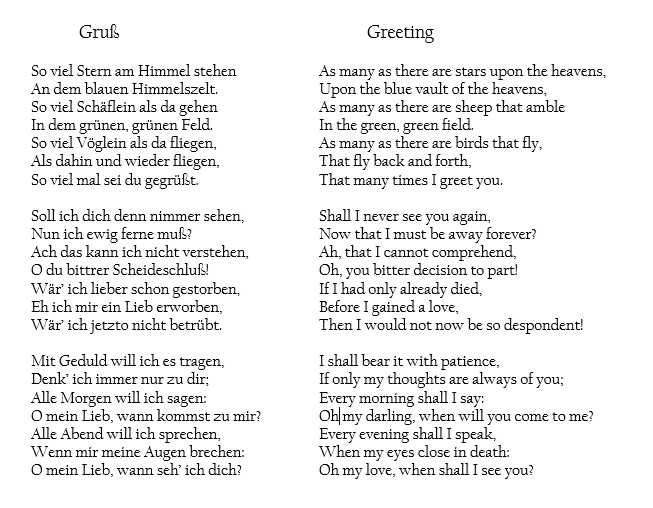
Below is my favorite of the three: the last song, “Gruß” (Greeting), based upon a folk poem originally published in Achim von Arnim and Clemens Brentano’s collection Des Knaben Wunderhorn. (The text and translation appear below.) The song is as close to a perfect setting of this text as I can imagine: spare and haunting like Schubert’s “Der Leiermann,” with vocal lines that intertwine, as though embracing one another in a way that the lovers cannot. This is a composer in full command of her craft, an artist whose songs deserve to be heard more widely.
Notes
Friedrich Chrysander, Allgemeine musikalische Zeitung 1 (7 Jan. 1874).
Natasha Loges, “Detours on a Winter’s Journey: Schubert’s Winterreise in Nineteenth-Century Concerts,” Journal of the American Musicological Society 74/1 (2021): 1–42.
Laura Tunbridge, The Song Cycle (Cambridge: Cambridge University Press, 2010).