
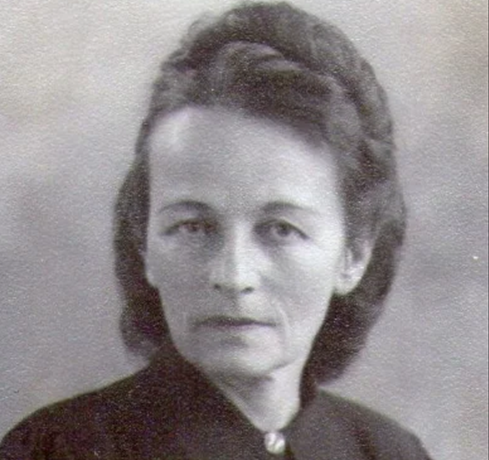
As time recently passed another anniversary of Russia’s invasion of Ukraine, I have needed to reflect on the resilience of Ukraine’s cultural legacy; in particular, I have turned to the work of one lesser-known Ukrainian composer who championed Ukrainian identity, Stefania Turkewich (1898–1977). Though her name may be unfamiliar, a community of musicians reviving the trove of Ukrainian art song, spurred by the initiative of Pavlo and Larysa Hunka, are bringing her work back to life, particularly her art songs. Their efforts are ensuring that, as Mikhail Bulgakov’s devil says in Master and Margarita, “manuscripts don’t burn.”
Born in the same decade as novelist Mikhail Bulgakov, Turkewich understood the power of culture, that according to centuries of Russian imperial world view, no matter how much you discuss the Ukrainian ethnic roots of Glière or Gogol, the light always shines brighter under an imperialist torch. Only last December did Kyiv Music Academy abandon Tchaikovsky’s name, 91 years after Turkewich received a doctorate in musicology – the first Ukrainian woman to do so – defending her boldly nationalist thesis at Charles University in Prague on the many Ukrainian elements in the operas of Tchaikovsky and Rimsky-Korsakov. As Olena Korchova, a professor at the Ukrainian National Academy in Kyiv recently stressed in an open letter, “With [Tchaikovsky’s] name we are also seen as the younger sister of our ‘great’ namesake, the Moscow Conservatory. However, our enemy is not Tchaikovsky himself, but only his simulacrum” (Korchova). Turkewich would have agreed.
Under Bolshevik power, little different from the times of tsars, hundreds of authors, poets and artists of the ‘Ukrainian Renaissance’ were shot dead, their works destroyed and banned, cloaked in silence. Turkewich, luckier than most, escaped to the west, her exiled voice a whisper from afar. Uncovering her work celebrates her contributions as composer, teacher, and lifelong advocate of Ukraine’s language and poetry. Not only did Turkewich write orchestral symphonies, opera ballets and chamber music, she always championed Ukrainian themes and poetry, choosing poems of those personally close to her as well as those of the national bard, Taras Shevchenko. Later in life she set several poems by Vira Vovk, who had been a childhood friend of her daughter. Here is the first of two settings of “Silver Song.” Texts of the songs I discuss in this post, with translations by Maria Lukianowicz (Stefania’s daughter), are available here:
Turkewich came from a family with strong musical roots. Her father and grandfather were priests and her mother a professional pianist who had studied with Karol Mikuli, a pupil of Chopin. She taught and accompanied at the Lviv Opera. All the family played instruments. As Stefania described, “Mother played piano wonderfully at the center of everything. Father was on the bass, brother Lyono on cello with Marika and Zenko on violins. Father also started a family choir.” Turkewich played piano, harp and harmonium, as needed. While this was all fertile ground for the gifted young composer, she recognized the importance of hard work: “They say we are talented and that music comes naturally to our family, but music requires the most hard work. I worked consistently on myself and on my musical education.”
Turkewich entered the Lysenko Institute at 16, studying piano with Vasyl Barvinksy, a huge influence on Ukraine’s cultural renaissance scene. Both a composer of eloquent lyricism, a politician and public figure, Barvinsky was a victim of the later Bolshevik regime, his manuscripts burnt under mysterious circumstances. (He spent much of his later years reconstructing earlier works.) At 18 she went to Vienna later returning to Lviv to study philosophy, pedagogy and musicology. There she studied with Adolf Chybiński, Polish musicologist and ethnographer, the first at the time to encourage this discipline within the framework of a university education in central Europe. Chybiński turned Lviv into a major musicological research center and encouraged Turkewich in her first major composition. She later reminisced,
Do you know what my first piece was? The Divine Liturgy. In 1919, after the retreat of our army, we were in a mood of despair and spiritual suffering. We prayed fervently. I felt the need to pour out this grief in song and composed my first spiritual song at that time. From this arose the Divine Liturgy, which I eventually knew perfectly, because I often sang it.
Meeting her first husband, the graphic artist and painter, Robert Lisovskyi, led Turkewich to move to Berlin in 1927 and a chance to work with Schoenberg. From Schoenberg came a concise and taught sense of structure and textural spacing tinged with expressionist harmony. In 1930 they moved to Prague, where she studied with Zdenek Nejedly at Charles University and Otakar Sin at the conservatory, while also raising her young daughter. She taught piano, worked as an accompanist and despite difficulties of combining roles of student, mother, wife, pianist and composer. A love song she wrote to Lisovskyi, “I Shall Come to You” by the poet Yuri Lypa, includes a reference to their shared longing for their homeland: “We shall call to the distant land together:”
The high point in her development as a composer came when Vitěszlav Novak approached her after a performance of one of her compositions offering to work with her. “For some reason,” she recalls,
I was afraid of his majesty, but a wonderful relationship developed between us. Once, Novak played me a new piece of his. He played it beautifully. The piece was so profound and I felt so tiny in comparison to it! I exclaimed impulsively: “I can’t study anymore, I don’t know how to do anything! I won’t compose anymore!” But Novak objected: “Don’t talk like that, I beg you! You need to study, that’s true. But you’re talented! I didn’t play it for you to discourage you!”
Novak, known for his impressionist yet individualistic style incorporating Czech folk idioms, encouraged Turkewich, who wove into her musical language Slavic folk elements without directly quoting specific motifs, embroidering Ukrainian flavor while remaining modern and broad ranging in style. Under his guidance she wrote a symphony, violin sonata and other chamber works, pursuing her dream of going to concerts and “living a real, intense musical life.” Her song “Evening Dance,” on another poem by Vira Vovk, references a Ukrainian custom of bringing young men and women together in fall and winter for match-making dances.
Studying at the heart of the symbolist and expressionist movements in central Europe among a rich literary and artistic scene, Turkewich developed an openness to new musical directions. Combined with strong tonal foundations, she possessed an array of expressive tools when she returned to Ukraine. Securing a position teaching at the Lviv Conservatory and the opera house she worked alongside her sister Irena, an established opera singer.
Up until World War II her works were performed among Lviv’s artistic society, but as the Bolsheviks took control, her abstract compositional language fell victim to the socialist-realist aesthetics of Soviet Russia. Her works banned, she fled with her second husband, Narcyz Lukianowicz, going first to Italy, then to Ireland and finally to England, where she composed a large body of work, including her children’s opera, “The Heart of Oxana” (also, “Oksana’s Heart”) recently revived in Canada. She died in Cambridge in 1977, leaving behind a substantial body of work meticulously preserved by her husband. Her songs in particular are full of a yearning, a melancholy for her homeland. Her oeuvre includes three symphonies, several symphonic suites, five ballets, 20 art songs and smaller chamber works.
Turkewich’s songs are not easy, either for pianist or the singer. Embedded with references to the beautiful Carpathian forests and mountains that surround her home city, Lviv, they are, like her life, full of angst reflecting pain, sorrow and heartbreak. Textural writing is spacious yet harmonically dense, often parallel octaves voiced in outer registers add sparseness at the extremes of the piano, while complex polyphony weaves in-between.
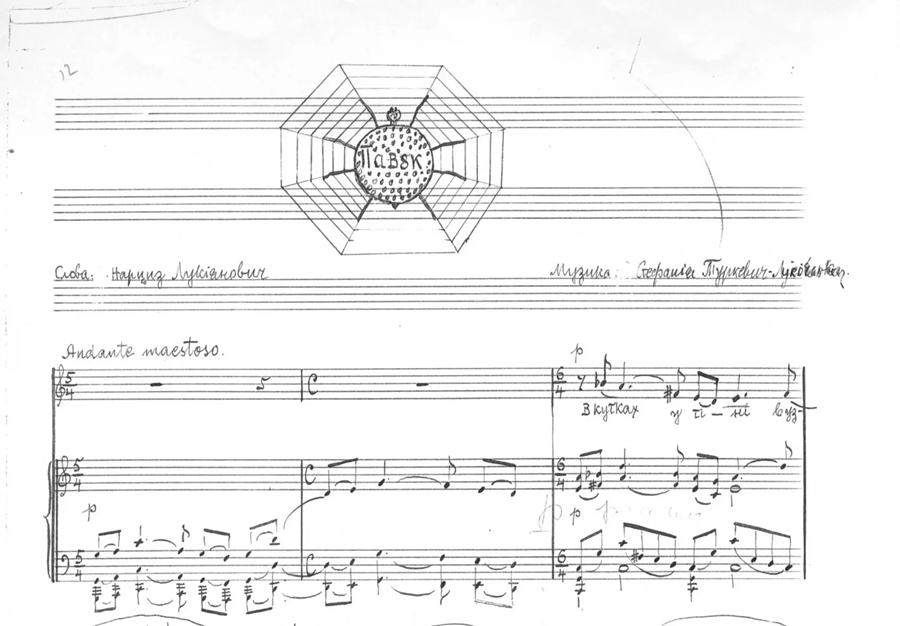
One of her most remarkable songs is the “The Spider” composed during her years in Prague, a setting of a poem by her second husband. It is sung hauntingly by Pavlo Hunka on the “Galicians” Art Song Album. The text differs from the usual themes of loss or parting. Dark and obscure, phrases move uncertainly. Open octaves in bass registers rise, harmonies ambiguously shifting, never settling nor resolving, echoing the first lines: “In the shadowy corner, In a knot of filigree threads, Silent, immobile, almost absent, A small, threatening shadow. Mysterious silken lines hide the danger of betrayal.” The treachery of the web is conjured with an intensely felt drama yet there is a profound sense of expression that also speaks of love.
As the singer enters, chords begin to fill and lines move out in contrary motion, mirroring the spinning of a web. A brief solo pianistic interlude disrupts the verse, highlighting a silken transparency of harp-like arpeggiations. A change in tempo identifies the speed of a “bloody fight” growing in climax to dotted rhythms and a brittle mocking staccato. A scherzando march figure at odds to the initial stillness depicts the determined entrapment of the “perfidious net” until the opening returns, with eerie quiet and retreat. The final vocal declamation drops down to the word “spider” conclusively. Underneath, the piano shifts to a brief radiant major, before the bass raises one whole tone in a sinister shift. The final note in the highest register concludes with an ethereal shiver.
In contrast, the setting of her husband’s “My heart” is lighter, lyrically floating with a melodic line that blooms. I find it the most tender and intimate of her songs. Unusually for her, it resolves to the major chord on which it started. Calmer in mood, the text emphasizes “a caring lover to hold the heart like a fragile mimosa flower bearing it away from the pains of the world.”
The most poignant work of Turkewich’s collection is “Time Passes,” a setting of an extract from Shevchenko’s epic poem “Haidamaki,” which explores the volatile complexity of Ukraine’s violent history. Turkewich chooses very few lines but they stain with bleak brutality. The piano sounds in upper registers, bells chiming as summer days pass – days which, as the vocalist implores us to understand, pass in Ukraine burning. Expressed in a rising, questioning melodic phrase, the statement begs a response from the listener. The singer’s line descends in falling seconds, two staggered notes of unequal length representing the tears of orphaned children. The piano, like the “rustling of yellowed leaves” picks up motion with swirling figurations depicting “wild clouds,” nature echoing the disruptive course of humanity. Tortured intervals stretch across a wide melodic range as “wolves entering a village, howl at the stench of corpses.”
“Time passes” is a violent portrayal of war past and present. Other lines of the poem – verses which Turkewich did not set – speak defiantly,
Here where all flows and all passes,
where does it vanish and whence did it come?
The fool does not know, and the sage knows no better.
There’s life and there’s death. […]
The soul is alive. Its ordeal may be softened,
if someone will read these word teardrops of mine.
I will not have them buried for they are alive (trans. John Weir).
In Shevchenko’s poem, these verses offer hope, keeping the Ukrainian soul alive.
Thanks to Larysa Hunka, aided by the young Portuguese composer, Joao Costa, Turkewich’s works have been catalogued, edited and preserved digitally. Performances now occur regularly and there is at last a stunning album of art songs. Manuscripts for once have escaped the pyre, lighting a counter-flame to defend this beleaguered nation’s culture, nourishing its sovereign will to confront the aggressor. According to an old Slavic saying, the song is the soul of the nation:
“While a song lives – Ukraine lives.”
Notes
Please consider supporting the Ukrainian Art Song Project.
All quotations of Stefania Turkewich are translated from this article by Mariana Kovalenko from 15 November 2020.
Olena Korchova, an open letter via The Claquers, responding to Iulia Bentia, “The Enemy is not Tchaikovsky” (30 Oct. 2023).
John Weir’s translation of “Haidamaki” is available.
For more information on Stefania Turkewich see this article by Erika Kyree Glenn, and also her “Stefania Turkevych’s Heart of Oksana (1969): A Critical Edition of a Lost Ukrainian Opera.”
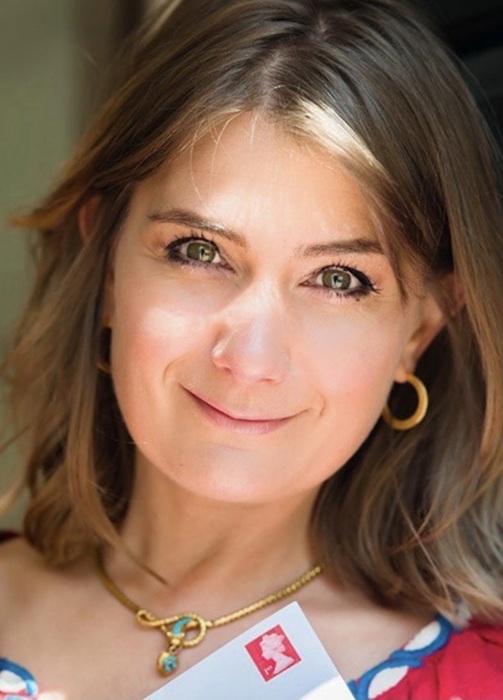
Guest Blogger: Eva Maria Doroszkowska
Eva Maria Doroszkowska is a Polish-British pianist who has performed internationally as soloist, chamber musician and lieder accompanist in festival appearances. Concerts include London recitals at the Royal Opera House, St. Martin-in-the-Fields, and Steinway Hall. Television appearances include broadcasts on the BBC and T.V. Polonia. She won scholarships to study at the Szymanowski Academy of Music in Katowice, the Royal Northern College of Music as well as postgraduate studies in the Conservatorium von Amsterdam and at the Royal Danish Academy of Music. In 2025 she was awarded an Honorary Associate from the Royal Academy of Music where she teaches. She specializes in Eastern European composers and her latest CD, Baltic Tides, features the solo piano music of female composers from Estonia and Latvia.