
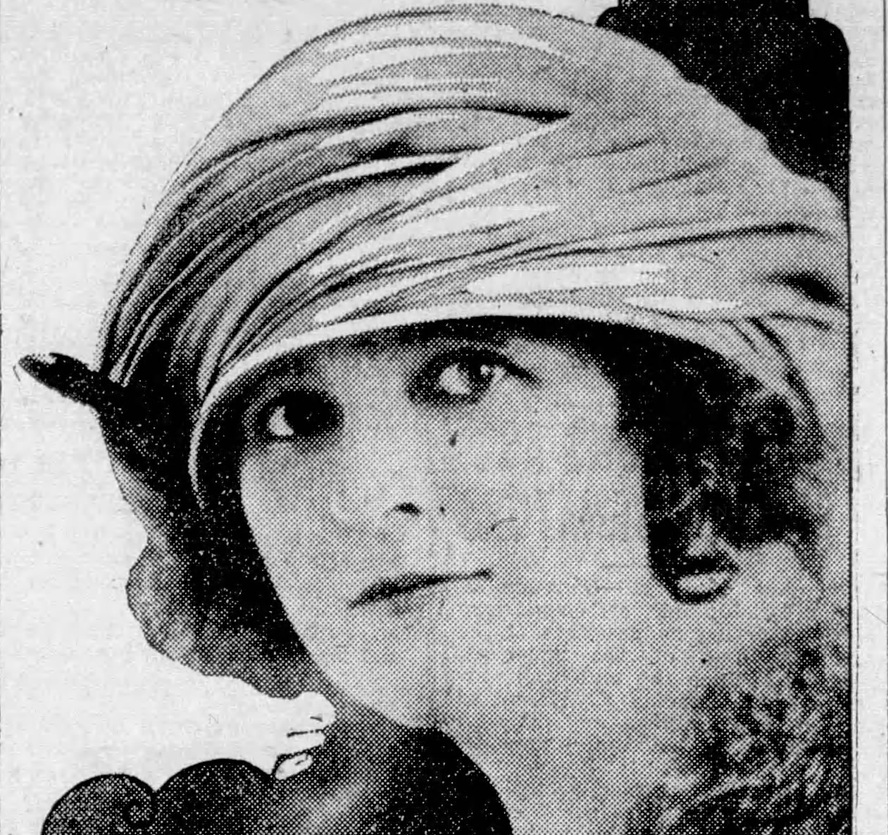
Each of the three verses of Lily Strickland’s “Mah Lindy Lou” poses a question, asking whether Lindy Lou has heard the mockingbird, smelled the honeysuckle, and felt the south wind. The song’s chorus then draws on this imagery as the wooing singer passionately exclaims that he would “lay right down an’ die” if he could treat his beloved like the clinging vine or the kissing wind. The Black dialect in the lyrics of Strickland’s wildly popular “banjo song” from 1920 links it to earlier racist “coon songs.” Yet “Mah Lindy Lou” had a musical life in women’s clubs and on recordings by Black and white singers long after most songs that had influenced it faded.
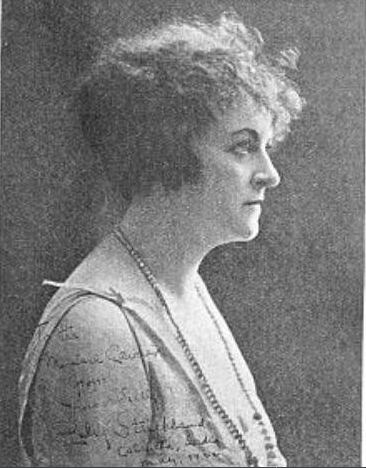
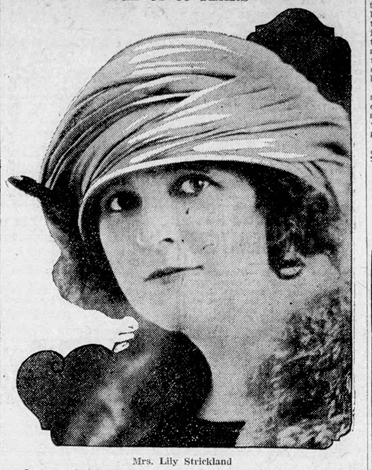
A pianist and composer, Lily Strickland (1884–1958) was also a poet who provided the lyrics for her own songs. She lived in India with her husband for almost decade, travelling internationally and publishing both articles about the music she heard and exoticist compositions. However, Strickland’s persona was closely linked to the U.S. South. Born in Anderson, South Carolina, the composer first produced songs in dialect. Her Southern upbringing gave “Mah Lindy Lou,” reportedly influenced by the sounds of her childhood, an air of authenticity. It and Strickland’s other dialect songs possibly influenced George Gershwin as he composed Porgy and Bess (Reynolds, 21).
Strickland’s song was only one of multiple evening serenades in which an African American man amorously woos “Lindy Lou.” While a few songs addressing Lindy Lou had no racial connotations, most portrayed Blacks in Southern settings, sometimes in Mississippi, Louisiana, or Alabama. The title of Thomas Allen’s “By the Watermelon Vine, Lindy Lou” (1904) reveals the proposed locale of the lovers’ rendezvous. Allen’s song was recorded many times and lasted in popularity almost as long as Strickland’s.
Later Lindy Lou songs were likewise saturated with stereotypes, not only romantic moonlight and warm breezes, but also, like Allen’s racist watermelons, imagery that relegated African Americans to the rural South: cotton fields, magnolia blossoms, and calling mockingbirds. In “Sugar Moon” (1910), Jaspar pines to “spoon” with Lindy Lou and in the chorus begs her to “Be my lovin’ coon.” The singer on the cover of “Honey Can’t You Hear Me Callin’: A Darkey Serenade” (1913) is shown with his banjo, an instrument long associated with Blacks, and says that he’ll be calling Lindy Lou “as long as that Swanee River flows,” referencing Stephen Foster’s minstrel show song.
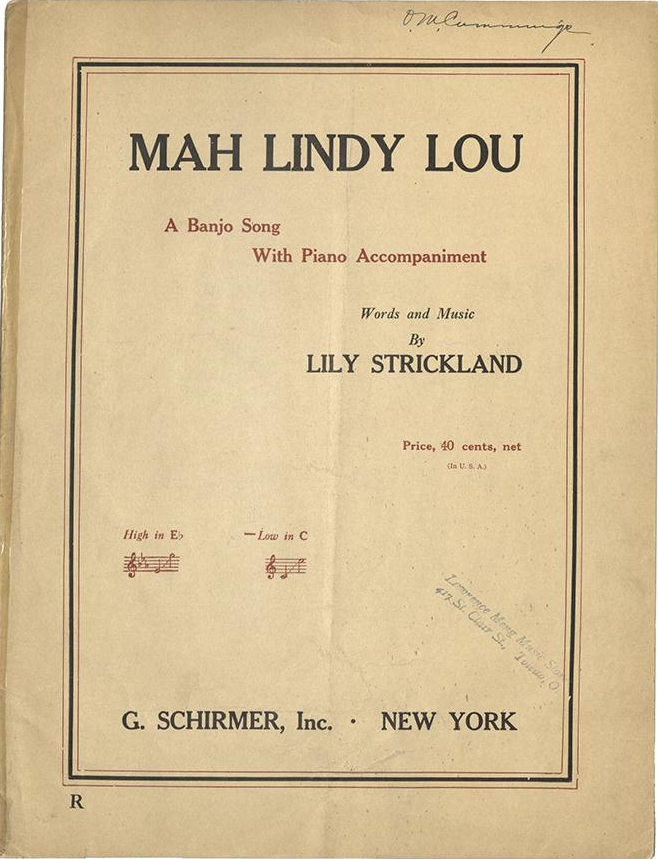
Although Lindy Lou songs were the commercial products of Tin Pan Alley, Strickland’s version managed to bridge a popular song/art song divide, in part because it was published by G. Schirmer with a typically staid cover, and in part because her lyrics were less overtly racist. After her death, one reporter described how even though the “twang of our southern soil is ever present,” the song was “elemental and noble,” inspiring listeners to nostalgic thoughts of “youth and love” on summer nights (Raleigh News and Observer, 17 June 1958).
These characteristics allowed “Mah Lindy Lou” to become a staple on the programs of white women’s clubs across the country for over three decades. Clubwomen, who were actively promoting American music in the 1920s and 30s, often chose Strickland’s song for their “American women composers” concerts and sometimes sang one of its many choral arrangements. The swinging rhythms and pentatonic flavor of “Mah Lindy Lou” also led them to program it as representative of “Negro music,” even though Strickland was white.
The perception of “Mah Lindy Lou” as more appropriate for clubwomen than lowbrow coon songs was both due to Strickland’s upper-class Southern roots and because its early recorded performances reflected classical music traditions. Oscar Seagle’s 1920 recording, perhaps the first, was praised due to his rich, resonant voice, though the press assured listeners that his interpretation drew on his experience leading African American singing in the Tennessee services of his preacher father. The 1924 recording by opera singer Amelita Galli-Curci was heard internationally, as her name appeared on the cover of a British edition of Strickland’s song. Galli-Curci performed “Mah Lindy Lou” using an odd mixture of dialect and operatic diction, such as rolled Rs. Audiences also heard the song on the recitals of other singers with operatic voices, including Louise Homer, James Melton, and John McCormick.
In contrast, a few performers emphasized the song’s commercial roots, downplaying its romantic expression with humor. In 1926, the Merrymakers’ recorded an arrangement with one voice, ostensibly Lindy Lou herself, responding to the ensemble’s serenade with “uh huh?” or “oh Lord!” Three years later Vaughn De Leath played up the song’s Southern setting, exaggerating her accent and the dialect. She spoke, rather than sang, the opening of the second verse, adding the aside, “did ya honey?” and later, a whistle. Jane Pickens’s recording opened with a vamping male chorus over which the song’s mockingbird twittered.
Undoubtedly the singer who solidified the reputation of “Mah Lindy Lou” was the great Paul Robeson, who recorded it several times, first in 1932. He transformed a song sung by whites in a genre that had capitalized on racial stereotypes to one fit for an internationally-renowned Black singer. Robeson, who had no hesitation in changing song lyrics that demeaned African Americans, came to abandon the dialect in Strickland’s text. Though his performances could have a jaunty character, he recorded a slower version around 1948 that featured lush orchestral accompaniment a world apart from a plantation banjo. Black choral groups sometimes performed “Mah Lindy Lou,” and sixteen-year-old future superstar Leontyne Price sang it on her recital for African American soldiers at an army airfield in Columbus, Mississippi, in 1943.
“Mah Lindy Lou,” sometimes called “My Lindy Lou,” continued to live on in highly varied recordings: as a traditional folk-song sung sweetly with a guitar accompaniment by Burl Ives (1949); as an extended jazz improvisation by the Bill Holman/Mel Lewis Quintet on their album, Jive for Five (1959); as a slow-tempo, sensual ballad by Johnny Desmond(1965); and as an art song by the Icelandic singer, Guðmundur Jónsson (1990). In the 1960s, Muzak recorded a version to be piped insipidly into businesses.
Lily Strickland, who produced almost four hundred compositions, appears to have tired of her most popular work, which she even heard played by a Chinese orchestra at a Shanghai hotel. In January of 1949, when the composer was invited to attend a meeting centered on American music by the Historical Book Club in Greensboro, North Carolina, she agreed – but only if “Mah Lindy Lou” were left off the program. However, there was no escape. When begged to provide the event’s encore, she stepped up to the piano and sang the work that had made her famous.
Notes
Lindy Lou Songs
By the Watermelon Vine, Lindy Lou (1904, Thomas Allen)
Sugar Moon (1910, Percy Wenrich and Stanley Murphy)
Honey Can’t You Hear Me Callin’: A Darkey Serenade (1913, H. C. Weasner and Jack Yellen)
Mah Lindy Lou (1920, Lily Strickland)
Little Lindy Lou (1925, Wendall H. Hall and Leland Johnson)
Additional Reading
Todd Decker, “Robeson’s Revisions.” In Who Should Sing Ol’ Man River?: the Lives of an American Song (Oxford University Press, 2014): 28–50.
Sam Dennison, Scandalize My Name: Black Imagery in American Popular Music (Garland, 1982).
Ann Whitworth Howe, Lily Strickland: South Carolina’s Gift to American Music (R.L. Bryan for the South Carolina Tricentennial Commission, 1970).
Frances Mims, “Lily Strickland: ‘Her Interests were Wide and Her Concerns were Deep.’” Anderson Independent-Mail(21 Nov. 1973).
Christopher Reynolds, “Porgy and Bess: An American Wozzeck,” Journal of the Society for American Music, 1/1 (2007): 1–28.
Marian Wilson Kimber, “‘A Stupendous Force’: The Women’s Club Movement’s Promotion of Music by American Women Composers,” Journal of the American Musicological Society, 79/3 (Fall 2026): forthcoming.