
The long heritage of songs, stories and films that begin with a mother dying in childbirth, leaving a father and child (or children) to fend for themselves, is one that I explored in an earlier post on one of Carrie Jacobs-Bond’s most popular songs, “His Lullaby” (1907). For most of her recital career, contralto Ernestine Schumann-Heink strategically placed this poignant tale of a father comforting his motherless baby at the climax of her program. Her rapt audiences routinely wept.
Jacobs-Bond pointedly did not compose in the popular styles of the day, songs influenced by ragtime, or those published in Manhattan by the commercial publishing houses that collectively became known as Tin Pan Alley. And yet she clearly took note of what people purchased and singers recorded. She had an ear for psychologically insightful poems that she could set to her simple yet emotionally potent music. In this post I’d like to situate “His Lullaby” in the broad context of other such songs, the majority of which were by the most illustrious popular songwriters of the day, including Gussie Davis (1896), Charles K. Harris (1901), Harry von Tilzer (1901), Harry Lincoln (1908), Al Piantadosi (1911), Henri Klickmann (1914), Grace Le Boy (1917), and the duo of Con Conrad and Al Sherman (1927). The choice of whether to write the song from the perspective of the child or the father/husband had implications for the musical style the composer chose.
The heyday of songs about motherless children
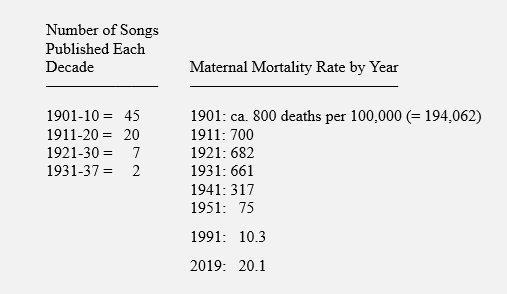
In the years between the end of the Civil War and the beginning of World War II, I have identified 101 songs about mothers dying and leaving a young child. Men composed 91 of them, women ten. The decade-by-decade distribution of these songs is unexpected:
1866–1870 = 6
1871–1880 = 7
1881–1890 = 3
1891–1900 = 11
1901–1910 = 45
1911–1920 = 20
1921–1930 = 7
1931–1937 = 2
Songs about a child wanting to contact the absent mother in heaven, or a tearful father trying to comfort a grieving infant exploded in popularity during the first decades of the 20th century. The underlying reasons for this were the (today) unimaginably high maternal mortality rates. Every community knew women who died in childbirth or soon after. Women giving birth little more than a century ago died roughly 40 times as often as they do today. In the table below, the column on the left repeats the numbers just given for songs published each decade, that on the right lists the rate (known or estimated) of mothers dying the first year of each decade (Hudson):
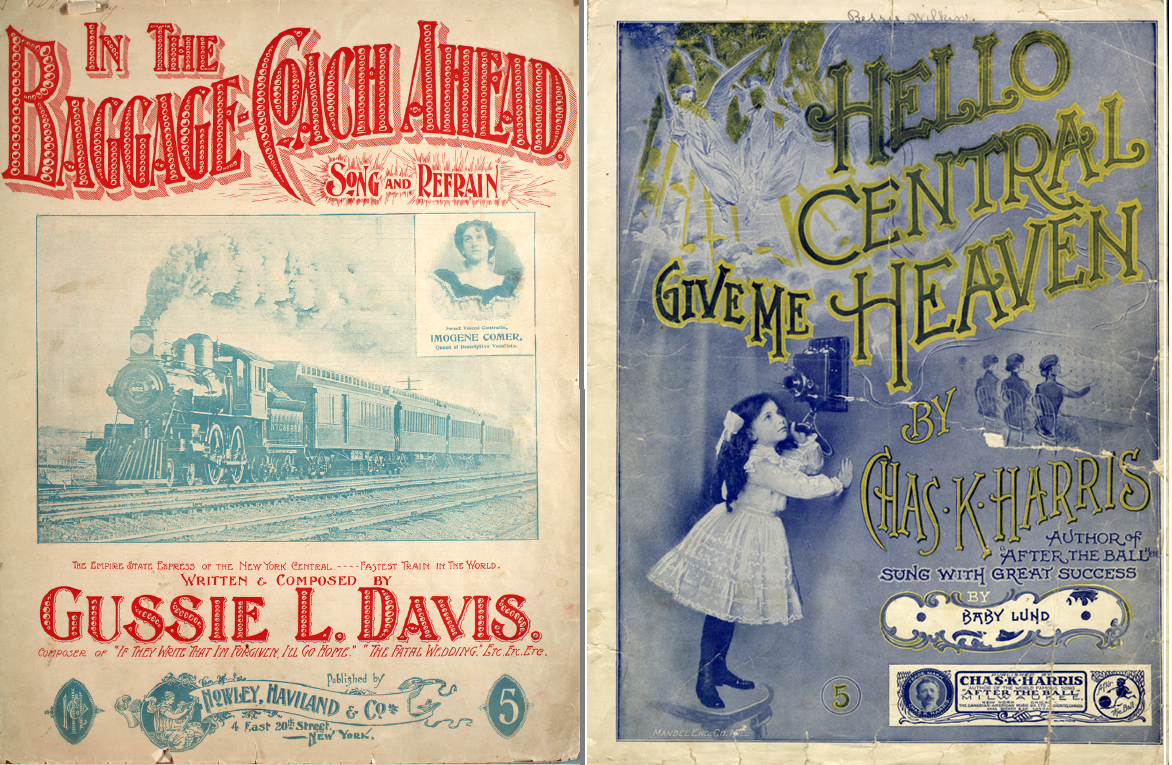
Nevertheless, these statistics only partially explain why these songs were so popular in the first two decades of the century. Maternal mortality rates had also been high in the decades that preceded 1901. Two best-selling tear-jerkers apparently sparked a fad that lasted a generation. Gussie Davis published “In the Baggage Coach Ahead” in summer 1896, telling the story of a man holding a crying baby in the train. When told to take the baby to its mother, the father replied, “I wish that I could … But she’s dead in the coach ahead.” Five years later Charles Harris opened the flood gates with “Hello, Central, Give Me Heaven,” which was based on a newspaper account of a young girl calling the operator and asking to be connected to her mother in heaven (Harris, 167–72). The chorus begins:
Hello Central give me heaven / For my mama’s there
You can find her with the angels / on the golden stair
She’ll be glad it’s me who’s speaking / call her, won’t you please
For I want to surely tell her / We’re so lonely here
The popularity of this song lasted the whole century and inspired a film by the same name in 1913. Harris profited greatly from this song, so much so that he regularly published spin-offs, five in all.
Songs from the perspective of the child
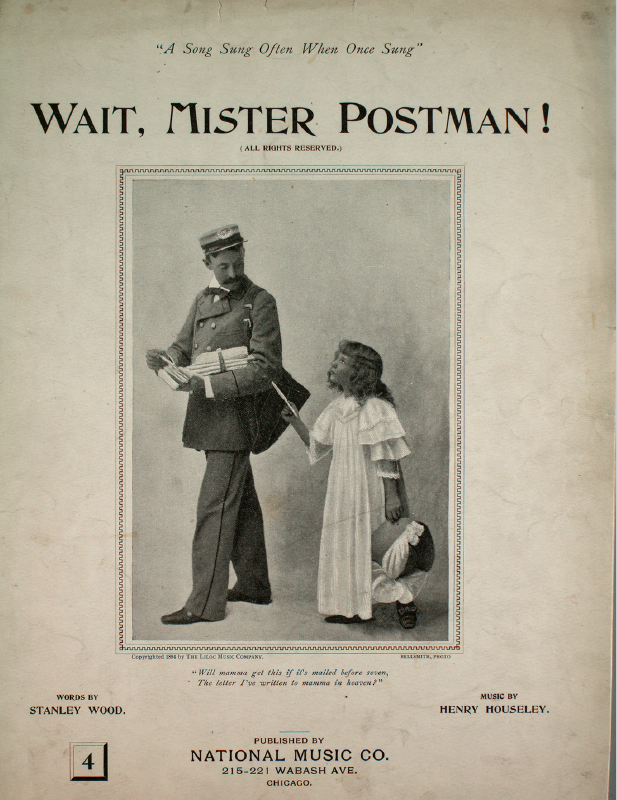
Most songs about mothers in heaven voice the thoughts of the children left behind. Before Gussie Davis lanced a national tear duct with “In the Baggage Coach Ahead,” Henry Houseley, a British organist and composer who had a distinguished career in Denver, Colorado, made national news with “Wait, Mister Postman” (Chicago, 1894). A little girl pleads with the postman to deliver the letter she’s written to her mother, addressed to “Mamma in heaven.” This may be the first instance in song of a child trying to contact or visit the absent mother, preceding trains, kites, cars, telephones, films, airplanes and radios. Houseley’s song was discussed in newspapers from coast to coast. Every few years, at least from 1890, newspapers reported incidents of a postcard or letter to “Mamma in heaven,” written in a child’s hand, being deposited in a mailbox somewhere.
The turn of the century being an age of technological innovation, many of the songs employed ever new ways to visit or communicate with “mamma.” In Harry J. Lincoln’s “Which Way Did My Mamma Go?” (1908), a little girl tries to find her dead mother in a “picture theater” at a performance of “The Passion Play;” J. R. Shannon returned to this idea in “Mister Moving Picture Man” (1912): “Oh, Mister Moving Picture Man, I came to see your show / There’s angels in the picture / And I came to let you know, My Mamma lives in heaven now / So start your big machine, Show my Mamma on the screen.” Within years of the Wright brothers’ first flight Kerry Mills came out with “Papa, Please, Buy Me an Airship” (1909), with the little girl pleading, “Papa, please, buy me an airship … We’ll sail till we see the bright Angels … And tell them we’ve come after mama.” Airplanes and recording technology had evolved significantly – and Charles Lindbergh had just crossed the Atlantic – when Vaughn De Leath recorded “Mister Aeroplane Man, Take Me Up to Heaven” (1927) about a boy wanting to visit his mother “who is waiting there.”
In the 1920s radios brought disembodied voices into the sitting rooms of private homes, something this niche of songs immediately seized on. The year Gershwin wrote about building a stairway to paradise, Eugene Lester published “I’m Building a Wireless to Heaven” (1922), in which the little boy promises to “talk to my mama each day.” Lucille Burton followed with “Please Get Heaven on the Air” (1926), the refrain beginning, “Dear Mister Radio Man, Please get Heaven on the air, If I cannot see her, I’ll hear her singing there.”
Father’s songs
Songs that focus on the bereaved father, like Carrie Jacobs-Bond’s “His Lullaby,” were more likely the product of composers who had been educated in Germany or England, or composers whose music is considered “light-classical.” Fourteen of the songs about motherless children have virtually the same title: “Father’s Lullaby,” “Daddy’s Lullaby,” “Papa’s Lullaby,” or “His Lullaby.” Hamilton Aïdé’s frequently published poem, “Father’s Lullaby,” attracted four composers between 1876 and 1897, including Brahms’s friend George Henschel. His emotionally stilted verses project the formality characteristic of Victorian family relationships, and yet through the Second World War they were sung frequently in the United States in C. Mortimer Wiske’s part song for four men (1883):
Lie at peace, my little one, / Let no fears alarm thee,
Lie at rest on Father’s breast, / Nothing there shall harm thee;
Mother to her home is gone, / To her home beyond the sea;
She hath left me here alone, / Baby, with no nurse but me.
Hush! Lie still my little one!
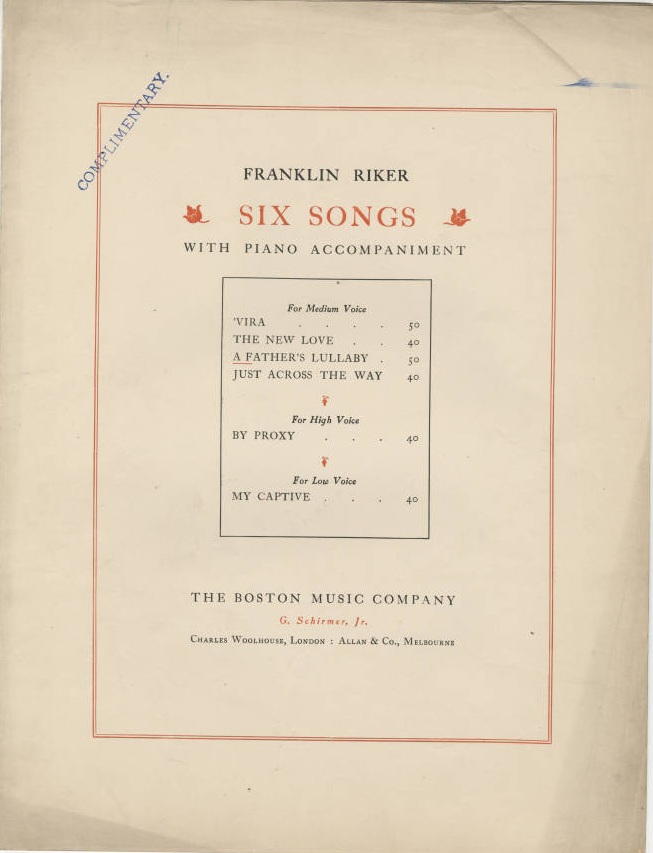
When Lucy Tennant wrote her poem, “A Father’s Lullaby,” set by Franklin Riker in 1905, she too wrote in a formal, quasi-Biblical voice: “Rest, little son, in father’s arms, / And hush thy pleading cry; / Thou’rt safe dear heart, though lonely still, / And father knoweth why.” Their publisher, Boston Music Company, reacted accordingly and routinely, designing its cover with dignified print.
This, then, is the musical community that Carrie Jacobs-Bond chose to join. She selected a poem by Robert Emmett Healy, a judge from Vermont. Several times she modified its wording to make it more formal, as in her rewriting of “And mama in heaven” as “And mother above us.” A year after she published this song in 1906, Charles Wakefield Cadman made his own setting of Healy’s poem.
“Mamma Number Two”
When a man with children lost his wife, it was common to remarry, often within a year or two (Grigg). That the transition for children to life with a stepmother could be challenging is evident in the popularity of three songs. Harry Von Tilzer struck a nerve with “Mamma Number Two” (1901). The daughter tells her father that her new mother “has made me cry, ’Cause she took away the picture / Of mummie who is in the sky.” Bamforth & Company chose this song in 1909 to be one they depicted in a set of postcards. Here is the first card of three:
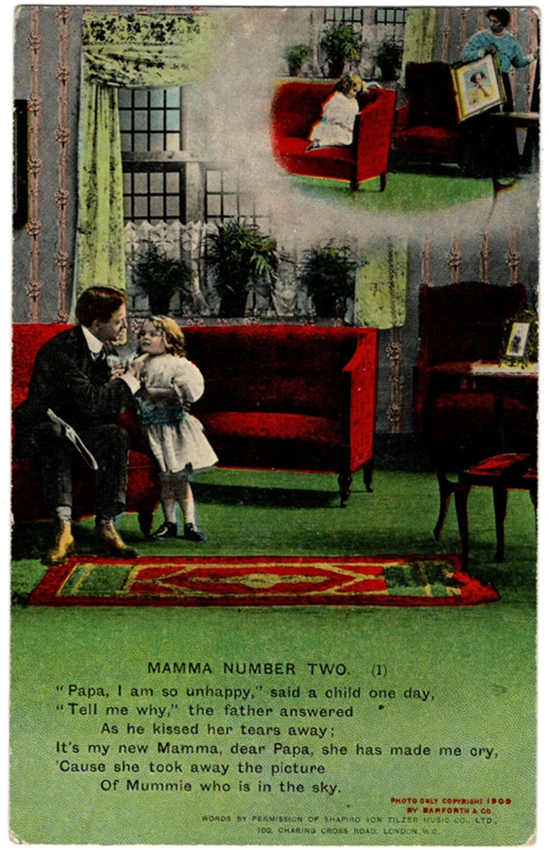
Not to be outdone, Charles K. Harris answered this idea with two versions of his own: “Always in the Way,” (1903) has the daughter complain to a stranger that this is how she feels around her “very cross” new mother, who “scolds me every day.” He followed that song with a new version of Von Tilzer’s photographic scenario. In “There’s Another Picture in My Mamma’s Frame” (1907) the daughter and stepmother have yet to meet; to prepare for the arrival of his new wife, her father has changed the picture on the wall.
Of the 101 songs I have identified on the topic of maternal mortality, only a few are still played or discussed. But as a group these songs constitute a musical-poetic tradition that has vanished both from our musical memories and from historical accounts of the period. Despite the rise in maternal mortality that is following the closing of women’s health clinics in many of these United States, the numbers of women who die – though unacceptably large in comparison to other developed countries – are but a small fraction of what they were just four generations ago. And despite the enormous variety of topics popular songs of today address, maternal mortality is not one of them.
I know of one exception. Composer and violist Michael Kimber recently composed a reflection on Harris’s “There’s Another Picture in My Mamma’s Frame.” He was invited in 2015 to do so by the ensemble, Red Cedar Chamber Music, run by Carey Bostian and Miera Kim, to honor songs for which the Magic Lantern slides are preserved in the Brinton Collection of the University of Iowa Library.
The lack of a woman’s voice in these songs is striking. The poems by women that I have been able to access are indistinguishable from the male voices that dominate this strain. Although Jacobs-Bond wrote half of the poems of her own songs, in “His Lullaby” she elected to set a poem written by a man. I know of no songs that talk about women’s fear of dying in childbirth, or deathbed songs of a mother lamenting that she won’t be able to raise the baby to whom she’s given birth. Nor have I seen any words as forceful as those of Elizabeth Barrett Browning, who addressed maternal mortality directly at the start of Aurora Leigh (1857), her novel in verse. This excerpt was anthologized as a poem titled “Motherless” in Joseph Bachelor’s The Book of Mother Verse (1924):
…. My mother was a Florentine,
Whose rare blue eyes were shut from seeing me
When scarcely I was four years old, my life
A poor spark snatched up from a failing lamp
Which went out therefore. She was weak and frail;
She could not bear the joy of giving life,
The mother’s rapture slew her.
The irony of the final two lines was beyond the capacity of popular songwriters in this period to convey. They confined themselves to poetic expressions of sorrow and grief and an idealized view of motherhood voiced in the imagined thoughts of children.
Notes
I have posted the list of 101 songs about maternal mortality on Academia.edu, in the section of my page devoted to Women’s Song Materials.
Joseph M. Bachelor, The Book of Mother Verse, collected by Joseph Morris [pseud.] and St. Clair Adams (New York: George Sully & Co., 1924).
Laura Faulk, “Destructive Maternity in Aurora Leigh,” Victorian Literature and Culture, 41 (2013), 41–54.
Susan Grigg, “Toward a Theory of Remarriage: A Case Study of Newburyport at the Beginning of the Nineteenth Century,” The Journal of Interdisciplinary History, 8/2 (1977): 183–220.
Charles K. Harris, After the Ball, Forty Years of Melody: An Autobiography (New York: Frank-Maurice, Inc., 1926).
Valerie M. Hudson, “Combat Deaths versus Maternal Deaths, USA, 1900–2019,” August 2021
Elizabeth McCracken, An Anthology of Mother Verse, intro. by Kate Douglas Wiggin (Boston: Houghton Mifflin Co., 1919).