
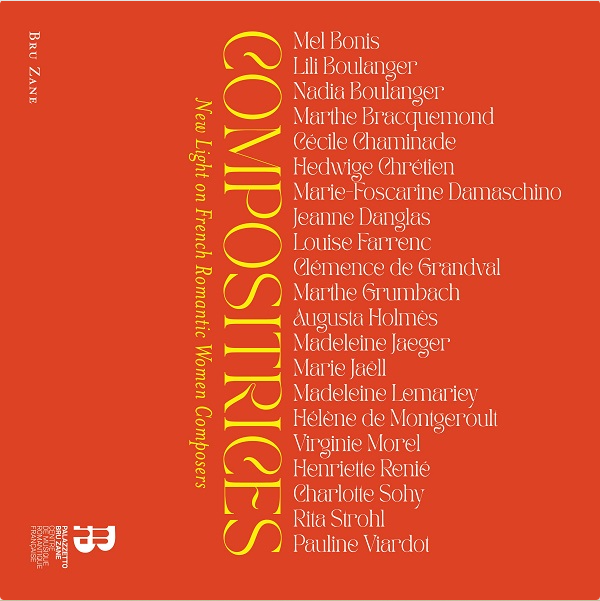
An astounding treasury of music composed by French women in the 19th-century was released in 2023 by the unique and well-funded Palazzetto Bru Zane (Center for French Romantic Music), whose headquarters are in Venice, Italy. The performers on this diverse 8-CD set of vocal music, chamber music, and orchestral works include Anaïs Constans (soprano), Aude Extrémo (mezzo), Cyrille Dubois (tenor), and Claire Le Boulanger (flute), along with Roberto Prosseda, Alessandra Ammara, and Nathalia Milstein (piano), and other vocal and instrumental soloists. The ensembles include the Capitole de Toulouse National Orchestra, the French National Orchestra, Les Siècles, and Metz Grand Est National Orchestra, led repectively by Leo Hussain, David Reiland, François-Xavier Roth, and Debora Waldman.
Together they have made available 10 hours and 12 minutes of recent recordings (often the first-ever) of little-known works in a wide range of genres. Every track is available password-free on YouTube in the same sequence as on the CDs. The set bears the polyglot title Compositrices: New Light on French Romantic Women Composers. The word “Compositrice” – a relatively new coinage, giving “compositeur” a feminine ending – sounds less bizarre in French than, say, “composeress” would in English. The excellent and nuanced introductory booklet-essays by scholars Alexandre Dratwicki and Étienne Jardin indicate that two instrumental works were recorded before, and I noticed a few others. Still, perhaps 8 of the 10 hours of music heard here, including all or nearly all of the vocal music, has not been heard in a century or more, let alone recorded.
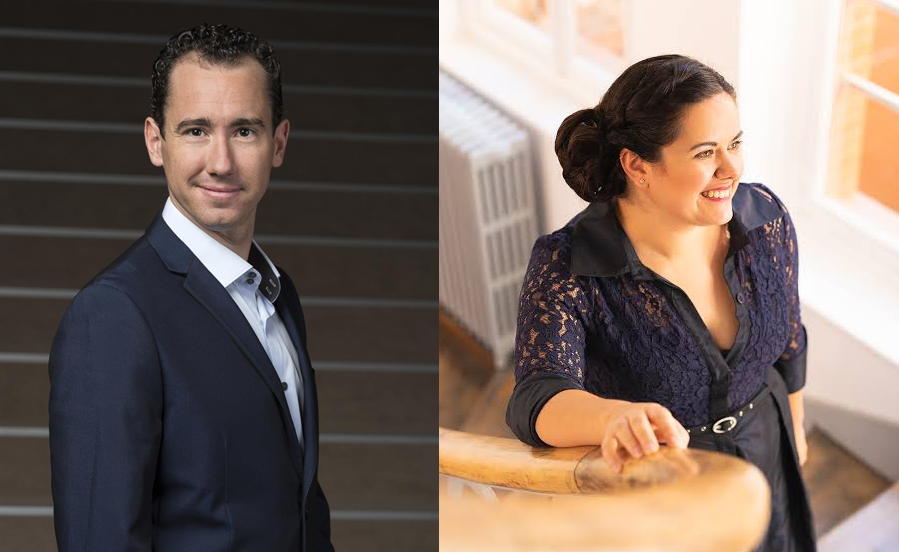
Glancing at the contents of the various discs, in which certain performers keep recurring, one might think that the box is an assemblage, reshuffled, of recordings previously released on individual CDs. In fact, though, all the recordings were made in recent years and saved up for this special release, which I should stress is available online for around $6 per disc.
Twenty-one composers are represented. Each of the eight discs has been arranged as a kind of “sampler” concert, alternating orchestral and chamber-ensemble pieces with piano-accompanied songs and some vocal works with orchestra. We hear mostly complete works, not isolated movements. This “sampler” arrangement encourages serendipitous listening: one may put on a disc because it has a relatively better-known composer on it, or because it begins with something you’re in the mood for, such as songs (perhaps one sung mellifluously and thoughtfully by Cyrille Dubois, the most frequent solo vocalist here) and then be pleasantly surprised by an instrumental work or a cantata.
Four fine orchestras are involved, including the French National Orchestra and the period-instrument Les Siècles (the latter under its renowned founding conductor François-Xavier Roth). The recorded quality is excellent, though, inevitably, the acoustics vary with the hall and the performing group. A piano generally sounds more close-up in solo works, and then the mics move back if the next piece has piano plus a singer or string player.
A full appreciation of this harvest offering could perhaps occur at some kind of public conference or celebration, at which specialists would examine the various genres and individual composers, elucidating, with sound clips, the many pleasures and surprises to be found in the boxed set. Instead, we are given nothing but a 100-page booklet, which may sound substantial, but it’s far too thin for the purpose, since everything is printed in three languages (English – French – German), and many pages are devoted to photos of the composers and performers and to listings of the members of the four orchestras.
I miss a brief commentary on each of the pieces: what its title refers to, how it fits into the composer’s output and relates to other pieces in that genre, and whether it got performed and reviewed during the composer’s lifetime. Sometimes a piece is given in two contrasting versions. The three-minute song by Jeanne Danglas presented above appears also on a different CD in Danglas’s arrangement for orchestra without voice:
And the sung texts of the vocal works should have been made available, at the very least in French, but ideally also in English and German. We do at least get excellent short biographies of each composer, often more complete and reliable than what one can find anywhere else, whether in print or online. In this regard, an aside: a major reference book on French women composers, by Florence Launay, appeared in French in 2006 – its title likewise begins with the word “Compositrices” – and has never been translated. By now, it deserves to be substantially revised, if the publisher, Fayard, will permit this, and then translated into English!
In some cases, the listener can repair the lack of printed texts by searching online, such as at www.lieder.net (which has some 42,000 generally reliable song translations). One clue: some of the songs here use the same texts that were set by, say, Fauré or Debussy. And often the “new” setting feels just as apt and engaging, showing the text in a new light. Still, I hope that the devoted staff of the Palazzetto Bru Zane will upload all the song texts to their copious website, even if only in French, as they have done for one piece by Nadia Boulanger (see below).
Enough carping, though, for there are amazing riches to explore here! Some composers are already semi-familiar (Farrenc, Chaminade, Lili Boulanger). Some published under gender-obscuring pseudonyms or shortened names: Mel Bonis (seven songs here) was born Mélanie; Marie-Foscarine Damaschino (three songs here) turned herself into Mario Foscarina (perhaps the final a in the pseudonym was meant to hint obscurely at the secretive gender switch); and Charlotte Durey, who had a mutually supportive musical marriage with composer Marcel Labey, published under her maternal grandfather’s name, Charles Sohy. She is praised in the biographical sketch for her vocal works. And justly so, if the three confident, grandly scaled songs to her own evocative poems evoking “confidence,” “peace,” and “joy” that end CD 1 are any indication.
Some composers, like Farrenc and Chaminade (two songs here by the latter, plus instrumental pieces), got their works published and performed and were honored with awards and professional positions. Others ended up writing for the desk drawer. Virginie Morel, who Étienne Méhul thought had the makings of a major pianist, ended up spending ten years in French-colonial Algeria when her soldier-husband was posted there, after which they settled at his family’s provincial chateau. She managed to publish a few works, but what more might she have done musically if she had lived most of her life in Paris or Lyons?
Many of the scores used here have been prepared for performance and recording by Bru Zane’s indefatigable team, led by Dratwicki, Jardin, and Sébastien Troester. Fortunately, most of the works can now be found on the Petrucci site, IMSLP.org. BruZane will help provide materials to enable further performances. Additional information on many of the composers is at their website.
And how do the works hold up? Thanks to the mostly excellent performances, very well indeed! The entire eight discs held my attention, though partly because I listened to just a work or two at a sitting, often choosing two works that I thought might relate to each other or might contrast interestingly.
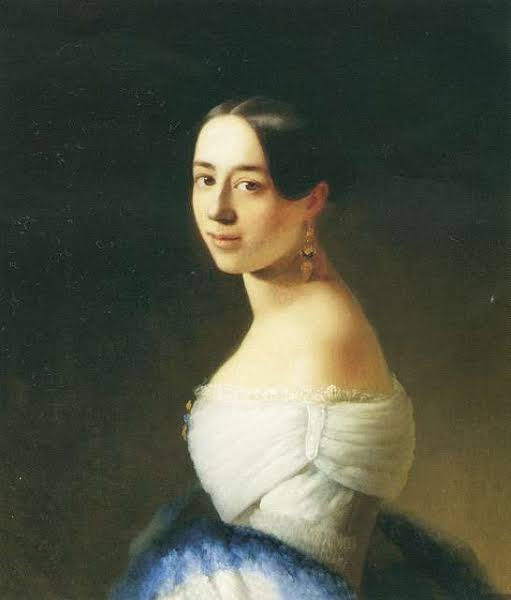
Pauline Viardot comes off as a major presence. She was known to be the century’s greatest mezzo-soprano, but also was a first-rate pianist, and friend to many major composers. We are treated to a delightful Sonatina for violin and piano, in three concise and contrasted movements, and two groupings (on different CDs) of songs in French or Spanish – twelve in total – sung with masterful control and insight by Aude Extrémo, a singer I have admired in Spontini, Offenbach, and in the grand opera Herculanum by Félicien David (formerly viewable on YouTube and perhaps soon to return). Here she performs Viardot’s, 6 Mélodies et une havanaise: No. 4, Haï-Luli!
CD 6 contains Nadia Boulanger’s La Sirène, the large-scale and highly dramatic cantata for soprano, mezzo, tenor, and orchestra. This work won her a second prize in the 1907 Prix de Rome competition. The text is long and high-toned; one can find it online, alas only in French, at the site of the Palazzetto Bru Zane’s Center for French Romantic Music. Here is the opening section:
Disc 3 concludes with the Introduction and “Song of Sadness” (or “Pain” – the word is douleur) from Marie Jaëll’s secular oratorio (if that is the best genre description for it) Ossiane (1879), for which she wrote both the text and the music. This long and complex work is, as far as I know, still unpublished. Ossiane had one public performance in Jaëll’s lifetime and has perhaps never been heard entire since then. The imaginary character in the work’s one-word title is a female philosopher-poet who goes on a spiritual search through the universe. Her name is essentially that of the legendary Scottish bard Ossian, but given a feminine ending. If the work were in Italian, the name Ossiane would be Ossiana. Liszt was a great advocate of Marie Jaell’s compositions and addressed her in letters as “Dear Ossiana” or sometimes “Dear Admirable One.”
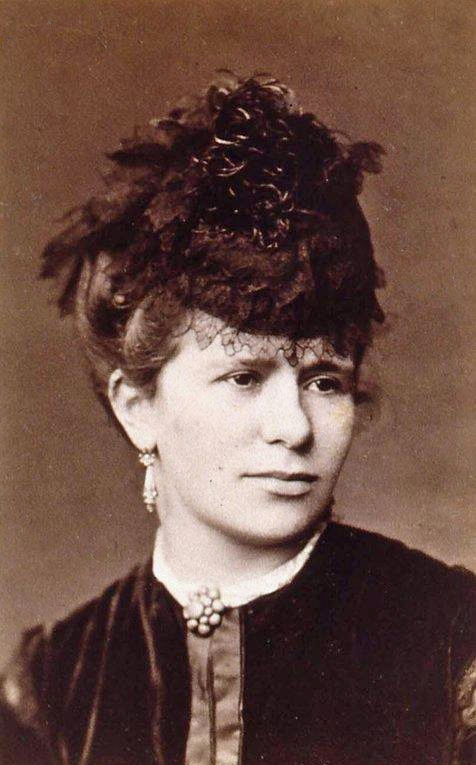
The introduction to Ossiane is a stirring miniature symphonic poem, very much in the manner of Liszt’s works in that genre, with dark, brooding orchestration and much use of unsettled diminished harmonies. The “Sorrow” aria for soprano is full of yearning and soaring – what I wouldn’t give to hear the whole work! The soprano here, Anaïs Constans, is at once pure and inspired. I have previously praised her performances in quite diverse operas by Cherubini, Saint-Saëns, and Offenbach.
The writings in the booklet are sometimes translated too literally. For example, “a transversal exploration” here should instead have been something like “when listening to a cross-section of these works.” (The French language delights in somewhat abstract nouns and adjectives, but good English prefers active verbs, as the old book by Strunk and White wisely recommends.)
Despite the limitations of its booklet, this 8-CD box deserves careful and repeated hearings by singers, instrumentalists, conductors, and concert organizers. The pieces they revive will delight and healthily challenge anybody who thinks s/he already knows what the Romantic and post-Romantic eras have to offer.
With regret at not being able to discuss all the works on these discs, I close by at least listing the composers whose songs I have not mentioned: Marthe Bracquemond (3 songs), Hedwige Chrétien (6), the Vicomtesse Clémence de Grandval (2), Marthe Grumbach (1), Augusta Holmès (4), Madeleine Jaeger (2), Marie Jaëll (2), Madeleine Le Mariey (2), and Rita Strohl (2). I’ll resist the temptation to tally the instrumental works included by some of these women!
I note that two of the lesser-known composers in the 8-CD box, Charlotte Durey-Sohy and Rita Strohl, have just had releases devoted entirely to them containing yet other works. And Étienne Jardin, a key member of the Bru Zane team, published a collectively written book about Mel Bonis in 2020. The musical world is finally starting to give these and other women composers their due, thanks to the efforts of imaginative performers and record labels. The harvest is quite impressive and leads me to wonder what other works – and, not least, what other songs and vocal works – by forgotten figures (whether female or male) have been unjustly left by the side of the musical road for whatever combination of reasons.
Notes
The banner photo is the album cover.
My review here focuses primarily on the songs and other vocal numbers. A fuller version, discussing many instrumental works, appeared in the March/April 2024 issue of American Record Guide and in the online arts magazine The Arts Fuse.

Guest Blogger: Ralph P. Locke
Ralph P. Locke is emeritus professor of musicology at the University of Rochester’s Eastman School of Music. Six of his articles have won the ASCAP-Deems Taylor Award for excellence in writing about music. His most recent two books are Musical Exoticism: Images and Reflections and Music and the Exotic from the Renaissance to Mozart (both Cambridge University Press). Both are now available in paperback; the second, also as an e-book. He is part of the editorial team of Music & Musical Performance: An International Journal, an open-access source that includes contributions by performers (soprano Elly Ameling) as well as noted scholars (Robert M. Marshall, Peter Bloom) and is read around the world.