
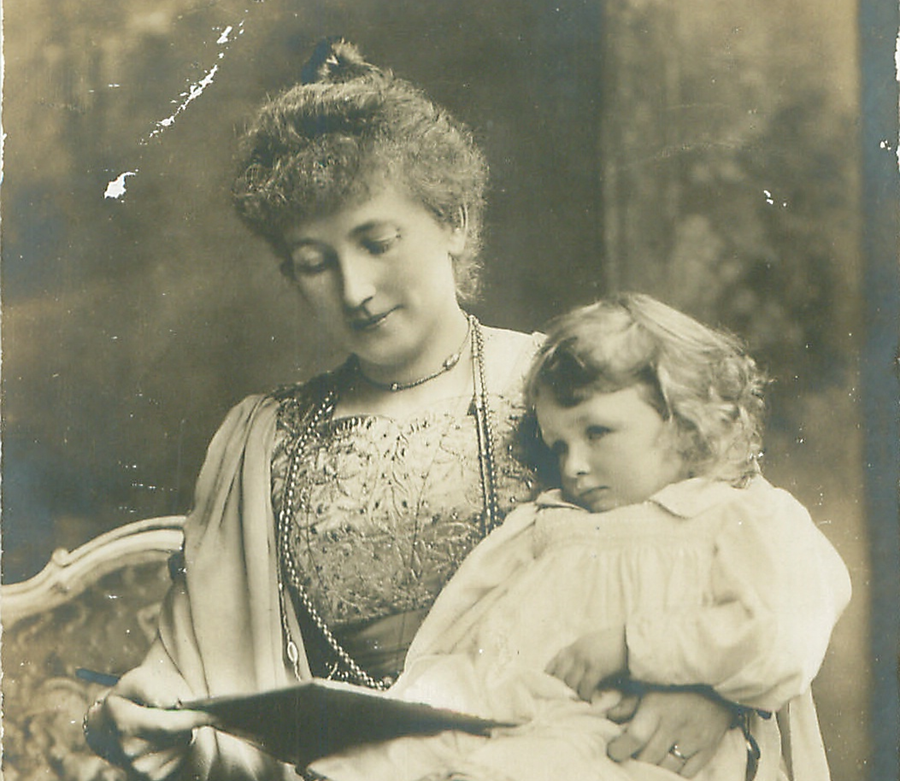
A century ago motherhood offered women composers strategic advantages in the marketing of their music. In Part 1 of this post, I focussed on the career and songs of Alicia Adélaïde Needham (born in1863). While there is more to say about her, we’ll begin this post with a consideration of her illustrious contemporary, Liza Lehmann (*1862).
Liza Lehmann: “Living Poems” vs. Artistic Autonomy
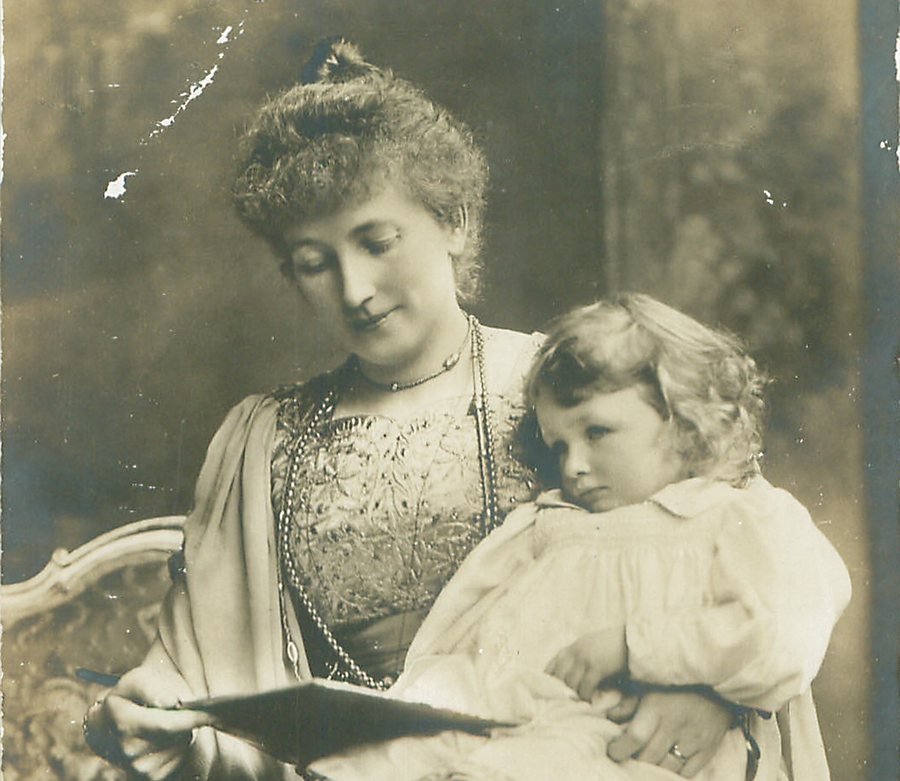
Needham was not the only one to use the photographic imagery of motherhood. Her colleague Liza Lehmann also relied on the visual power of maternal staging in her autobiography, published posthumously in 1919. Photographs of her sons Rudolf (*1897) and Leslie (*1900) are integral parts of her autobiography.
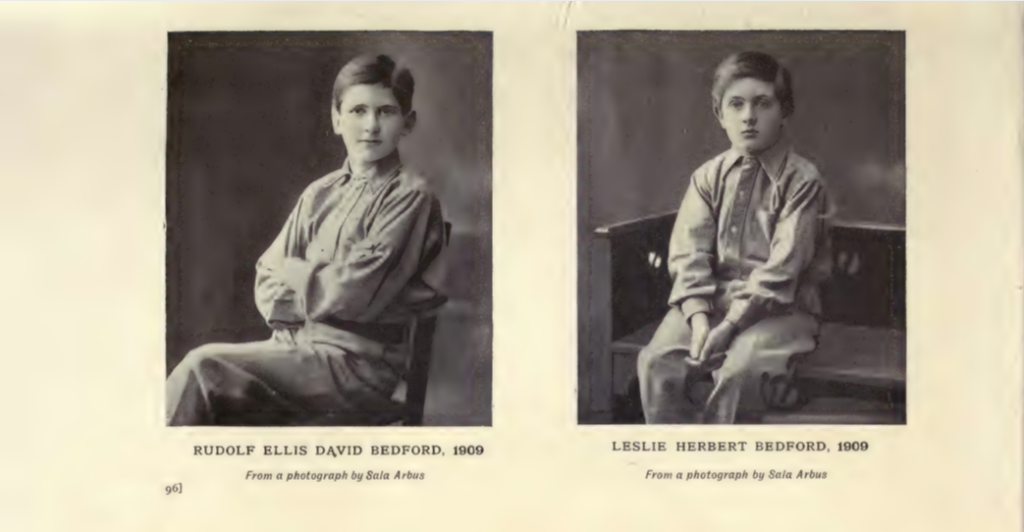
Lehmann used the text specifically to position herself as an “ideal mother” in the Victorian sense:
Meanwhile, my two little boys had been born — and I was far more wrapped up in my ‘living poems’ than in any art, however absorbing and fascinating. I inherited from my mother an enormously strong maternal instinct, and love of my children became the very mainspring of my existence. I have always — (thank God for the remembrance!) — placed them before my art and before any other interest in life. (Lehmann, 96).
This rhetorical subordination of art to motherhood was a necessary concession to societal expectations. Yet even in her autobiography, Lehmann narratively linked her children directly to her creative work, citing her 1900 song cycle for four voices, The Daisy-Chain. Twelve Songs of Childhood, which she dedicated to “My small son Rudolf,” then three-and-a-half years old.
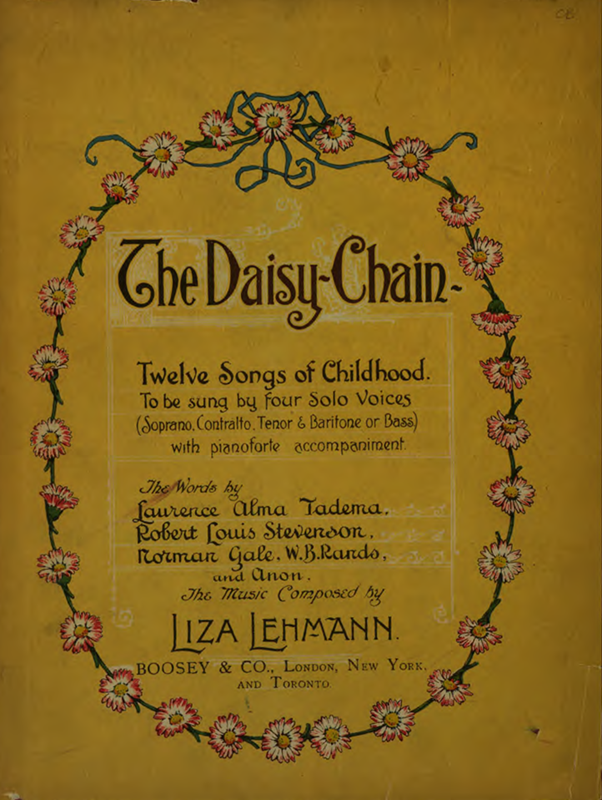
Lehmann set twelve poems by Laurence Alma-Tadema, Robert Louis Stevenson and others, in a style she described as being “written in a light-hearted vein” (Lehmann, 93). It includes quartets as well as solos. A characteristic feature is Lehmann’s virtuoso text-painting, for example in “The Swing”: the piano accompaniment oscillates in constant upward and downward arpeggios in 6/8 time, making the centrifugal force of the swing physically palpable for both performers and listeners.
Despite the enormous success of collections like The Daisy-Chain or its successor, More Daisies (1902), Lehmann felt constricted by the genre. She later lamented that after The Daisy-Chain, she was submerged by a “tidal wave of would-be-childlike effusions.” This might reflect the professional composer’s fear of being pigeonholed as merely a ‘child-song composer.’
Clara Butt and “Mother’s Joy”: A Medial Alliance
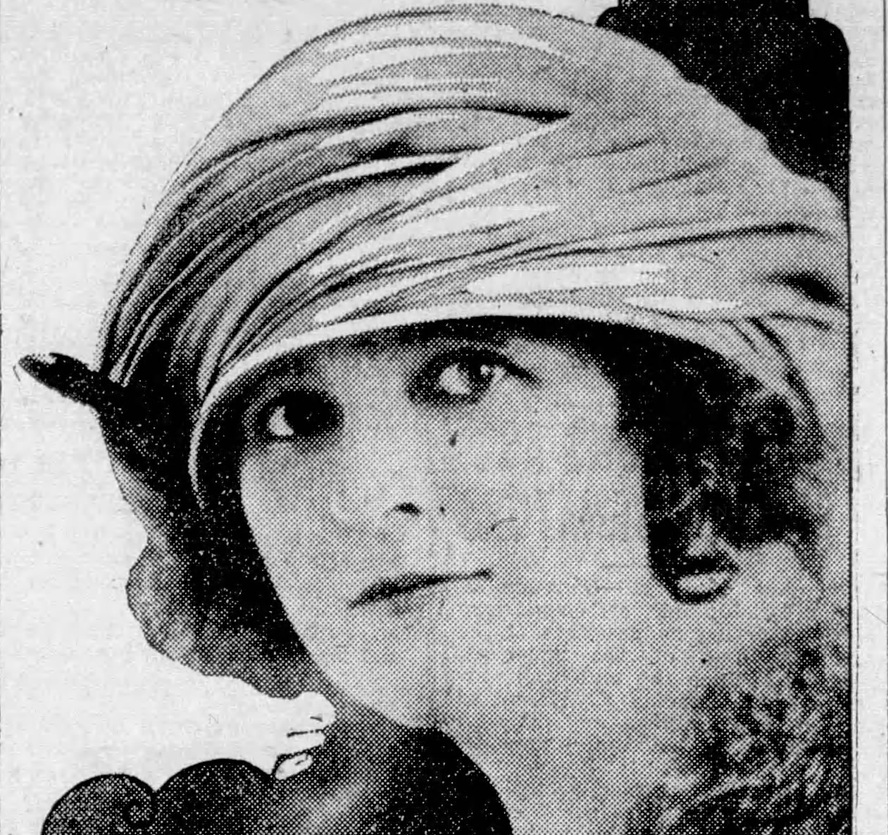
A potent manifestation of this staging of motherhood was the collaboration between Alicia Needham and the celebrated contralto Clara Butt. In 1901, about a year after the birth of Needham’s son, the song “Mother’s Joy” was published. The fact that this work became a success on the stage was also due to a remarkable biographical coincidence: Clara Butt had given birth to her first daughter in July 1901 – her name was Joy. The press seized upon this connection. The Musical Herald (December 1901) noted pointedly:
Madame Clara Butt’s daughter was only born in July, but she is already being exploited. Her name is Joy, and Mr. Hinkson and Mrs. Needham have severally written words and music of a song “Mother’s Joy,” which Madame Clara Butt is singing everywhere in a way that makes every mother in the audience weep.
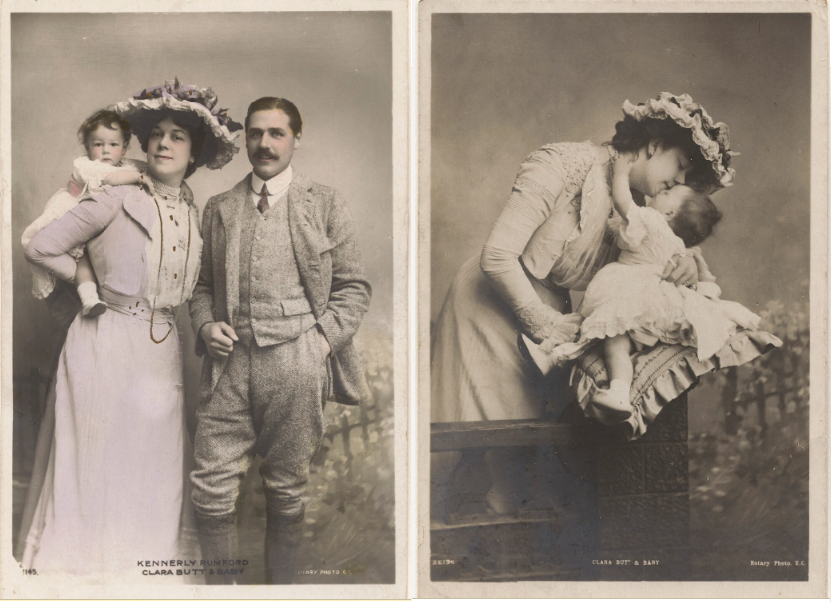
This quote is revealing: it speaks openly of an “exploitation” of a private situation for artistic success. When Clara Butt sang “Mother’s Joy” on the concert stage, the audience wept not only because of the music, but because of the visible and audible embodiment of motherhood by the star. This was supported by postcard prints showing the singer with her daughter, presenting her as the epitome of maternal fulfilment. The following two photos are two of several in the collection of the National Portrait Gallery, London.
“Mother’s Joy” – An Aesthetics of Protection
Anyone suspecting pure idyll in “Mother’s Joy” (subtitled East Wind) overlooks the deeper layer of Katherine T. Hinkson’s poetic text. A look at the lyrics reveals a motherhood under siege. The harsh East Wind functions as a constant threat, forcing the “birdikin” and “leafikin” into hiding.
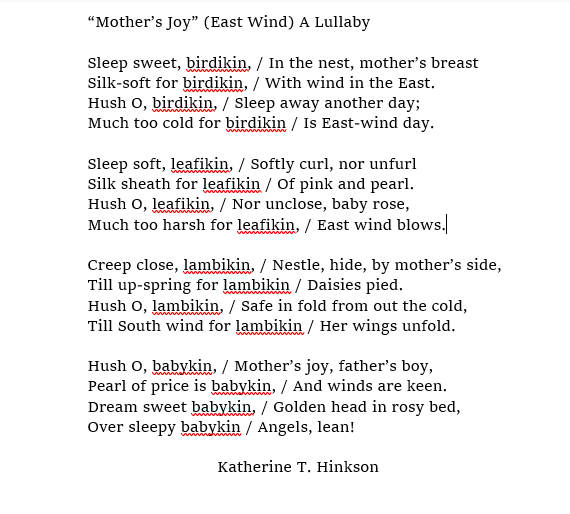
It is an aesthetics of protection: the mother acts as a buffer against a hostile environment. While the father is dutifully mentioned in the phrase “father’s boy,” he remains a passive, marginal figure. The active, protective presence belongs solely to the mother. The song evokes an intimacy (“Nestle, hide, by mother’s side”) that serves the ideal on the surface but, underneath, already announces the burden and the “keen winds” of reality.
Before we compare (and contrast) Needham’s actual experience of motherhood to this song, we are pleased to present the following recording by Ella Taylor, soprano, and Jocelyn Freeman, piano, a recording undertaken specifically for this post.
Reflections on Motherhood in Needham’s Diary and Autobiography
What was translated into a poetic natural phenomenon in the song “Mother’s Joy” finds a drastic counterpart in Alicia Needham’s private records. A look into her diaries (Cambridge University Library, A107/A108) shatters the illusion of effortless maternal devotion. Particularly in the first six months after the birth of her son Joseph, it becomes clear that the real “East Wind” consisted of sleep deprivation, physical weakness, and the immense pressure to defend her professional career against the crushing demands of care work and societal expectations of her as a woman and mother.
The entries – selected here as examples – trace a protocol of exhaustion that stands in sharp contrast to the con tenerezza aesthetics of her lullabies:
December 27, 1900: Just a few weeks after giving birth, she notes: “Worried more or less all day about Nurse not being engaged + I am too weak to be left alone with Baby + have so much music + letters to do.”Here, the precarious balance becomes clear: music is not a hobby but a burden that exists alongside physical weakness.
January 3, 1901: “Later on got horribly depressed. Baby cried so much. My head was splitting.” She also lists her “worries” here: her own body (“my Fatness”), the baby’s crying, the interrupted sleep, and – significantly – the unfinished compositions for the Feis Ceoil competition, for which she had successfully submitted a work the previous year.
January 20, 1901: When her son is six weeks old, she writes: “4 awful days of tiredness!” Nevertheless, she forces herself to work on her song for the competition: “I copied out the end of Innisfail but dead tired.”
The Music Room as a Subversive Space
These entries reveal that Needham’s experience with motherhood was far more than the fulfilment of a Victorian ideal. The ideal saw the maternal role as an “affirmation of identity” – a confirmation of female virtue that left no room for ambitions outside the home. A woman was expected to prove her femininity through “constant attendance,” meaning permanent presence and serviceability, as Lynn Abrams succinctly summarized for the BBC in 2001 (Abrams, Ideals).
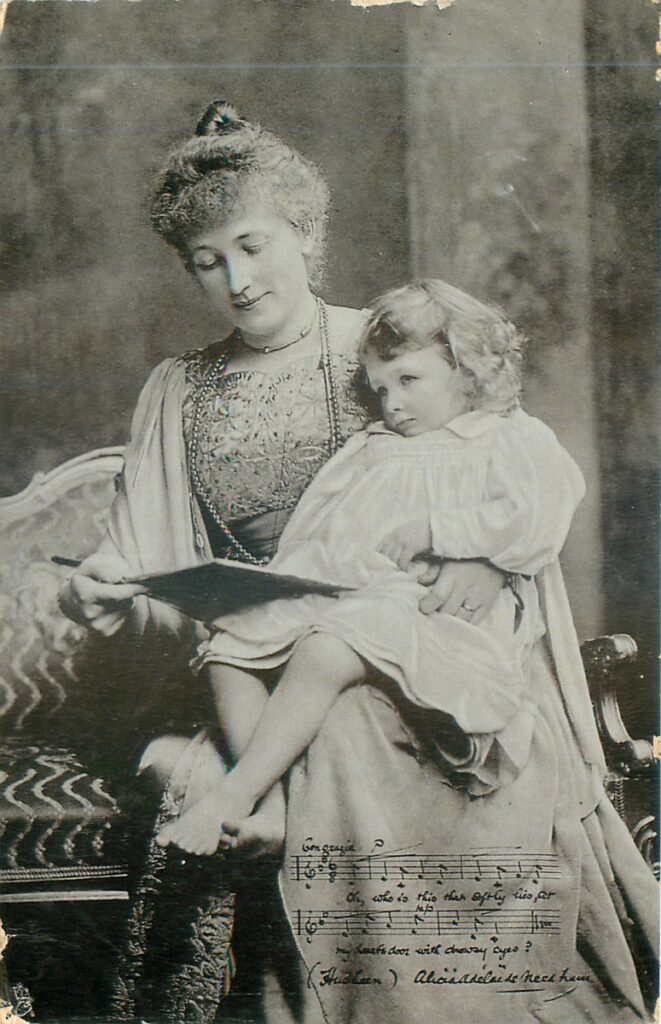
When Alicia Needham notes on 24 January 1901, that “I had Baby in music room while I copied music,” this can be interpreted as a subversive act. She fulfils the societal demand for physical proximity but refuses exclusive emotional self-sacrifice. By integrating the child into her sphere of production instead of abandoning her productivity for the child, she offers resistance. In a world that viewed motherhood as a substitute for a woman’s productive role, Needham insisted that both could exist simultaneously. Her compositions are thus not only musical works but testimonies of a hard-fought struggle for survival.
The “Supreme Self-Sacrifice”: Rhetoric vs. Reality
The fact that this balancing act between ambition and sacrifice occupied Needham throughout her life is evident in her unpublished autobiography. Here, she reflects almost wistfully on the freedom of childless women:
When women are childless or keep unmarried they may have time to develop their own powers, and make world-wide names for themselves, but women who make the supreme self-sacrifice stand happily aside to glory in the advancement of their children. […] [A]lways, always will they sacrifice themselves for their children (Needham, “A Daughter”).
This passage is marked by deep ambivalence. On the one hand, she speaks of the “supreme self-sacrifice” and of “standing happily aside.” Yet the undertone is bitter. Rhetorically, Needham internalized the ideal, while in practice, she fought for her artistic autonomy in every spare minute.
Her conclusion that women will “always, always” sacrifice themselves is less a biological observation than a painful acknowledgement of the patriarchal reality of her time. When we honor her today, it is not because she “happily stood aside,” but because she managed to leave behind a “world-wide name” despite this massive internalized pressure.
The Privilege of Resources
Yet we should not overlook one crucial aspect of her situation: this path of strategic self-assertion was inextricably linked to Needham’s privileged (class) position. That she was able to manage the balancing act between the nursery and the composing desk at all was due, not least, to the availability of domestic staff and nurses, as well as the financial security of her bourgeois background.
On 8 February 1901, she recorded the receipt of a check from Boosey for £232, an amount equal to approximately $48,800 today – a significant sum that legitimized her work. Her “survival strategy” was thus also a question of resources; she delegated a portion of the duties of physical care to preserve the mental space for her art. This perspective does not diminish her individual achievement, but it makes clear that the reconciliation of art and motherhood in the 19th and beginning 20th century was very much a privilege, often based on the invisible labor of other women in the background.
Beyond the Ideal – A Re-evaluation
When we look at the work of Alicia Needham and Liza Lehmann today, we encounter far more than just nostalgic lullabies and innocuous “children’s songs.” Engaging with works such as Husheen, Mother’s Joy, The Swing, or The Daisy-Chain reveals an ambivalent reality that eludes the simple image of the “happy Victorian mother.”
The musical portrayal of motherhood for these women must be seen as an existential survival strategy within their patriarchal world. In a society that viewed female genius with suspicion and inextricably linked “true femininity” to domestic self-sacrifice, Lehmann and Needham used the subject of the childlike and the maternal as a legitimizing shield. It was a Trojan horse: under the guise of maternal devotion, they secured access to the public music market, to substantial checks from publisher, and to national and international fame.A modern tribute to these composers must therefore not stop at admiring their “gentle sounds.” We must see them for what they were: strategists who fought for spaces for their creative power within a deeply restrictive system. Needham’s diary entries are just as important as her compositions in this sense; they document the price women such as her paid for their visibility – a currency of exhaustion, discipline, and the constant struggle against the “harsh East Wind” of societal expectations.
Notes
Lynn Abrams, Ideals of Womanhood in Victorian Britain (2001).
Maren Bagge, Favourite Songs. Populäre englische Musikkultur im langen 19. Jahrhundert (Hildesheim, Zurich, New York: Georg Olms Verlag, 2022).
Alicia Adélaïde Needham, A Daughter of Music (archived in Cambridge University Library in the Joseph Needham Papers as “MS Needham A.97”).
For other posts about motherhood and song, see the first installment of this post, as well as earlier posts from 2020, 2021, 2021, 2021, 2023, 2024, and 2026.