
Throughout her long career, Carrie Jacobs-Bond occasionally identified one of her most popular songs, “I Love You Truly,” either as her first song or her first publication. In 1922 a Hollywood reporter noted that at a recent performance, “Mrs. Bond gave interesting little side lights how some of [her songs] were inspired, or where they were written, while her beautiful philosophy of life shone through it all […] She said “I Love You Truly” was the first song she wrote, twenty-three years ago” (Holly Leaves, 1922). On other occasions, such as in her essay “Music Composition as a Field for Women,” she claimed it as the first song she had self-published (Jacobs-Bond, 1920).
But “I Love You Truly” was neither the first song that she composed nor the start of her publishing career. Although Carrie Jacobs-Bond had issued “I Love You Truly” in January 1901, as one of the songs in her break-out collection, Seven Songs as Unpretentious as the Wild Rose, she had begun to publish songs several years before. After selling the rights to her very first songs to S. Brainard’s Sons Co. in 1895 and 1896 – songs like “Is My Dolly Dead?” and “Write to Me Often, Dear” – Mrs. Bond gradually began to issue some of her songs and works for piano on her own in 1897.
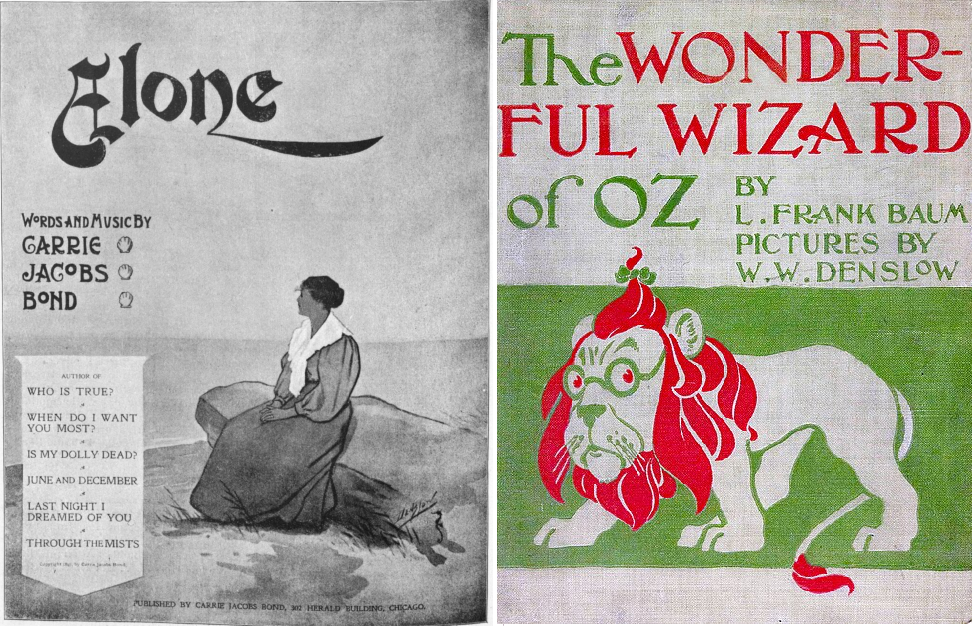
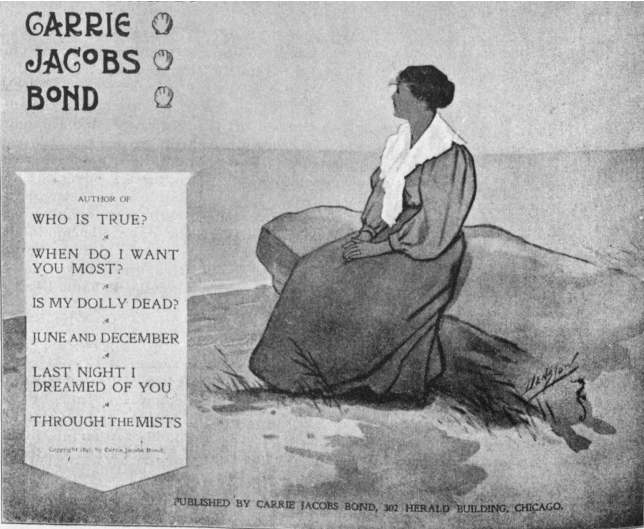
Her song “Alone” is evidently among the very earliest of these, and possibly the very first. For the song’s cover Carrie persuaded the up-and-coming Chicago artist W. W. Denslow to create an image that expressed the meaning of the lyrics. Denslow would soon achieve his own fame for his illustrations of L. Frank Baum’s The Wonderful Wizard of Oz (1900). It is clear that Denslow wanted to help Carrie launch her career, and not just because he had designed the cover. The address that she gave for purchasing copies – “Carrie Jacobs Bond at 302 Herald Building” – was not her apartment, but his studio. And to expand Mrs. Bond’s potential audience, he featured this cover and the song’s lyrics in his column in the advertising trade journal, The Bill Poster (July 1897).
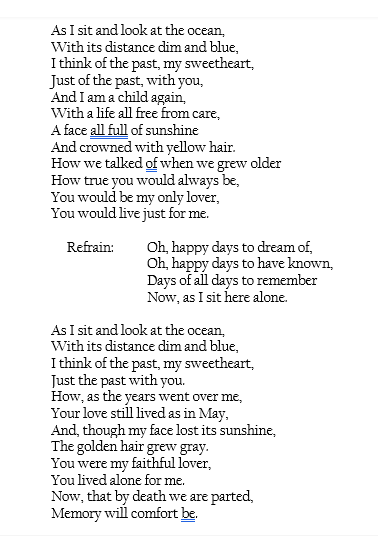
Denslow’s depiction of a middle-aged woman sitting on a rock looking out over the ocean set the stage for the poem, which voices the thoughts of a young widow who has made peace with her new solitude. The opening four lines of the poem move from the solitary present back in time to recall the cherished past: “As I sit and look at the ocean, / With its distance dim and blue, / I think of the past, my sweetheart, / Just of the past, with you.”
Carrie wrote the poem in the year after her beloved husband Frank Bond died in a tragic accident in December 1895. The image of her sitting and staring out over the ocean “with its distance dim and blue,” evidently drew on her recent experience of crossing the Atlantic on voyages to London and back in spring and summer 1896. These verses mattered enough to her that she placed them at the beginning of both stanzas:
Thanks to Denslow, the cover and the poem of “Alone” survive. Yet despite my searches in the Library of Congress, the New York Public Library, the Jacobs-Bond collection at the Rock County Historical Society in Janesville, and decades of regular perusals of eBay, Amazon and a range of other on-line dealers, I have been unable to locate even a single copy of the song with its music. Its disappearance is particularly surprising because Carrie sang “Alone” regularly for two years, beginning in May 1897. It was an audience favorite.
An enthusiastic critic in Albert Lea, Minnesota, called it a “masterpiece,” and predicted that it “will win a permanent place among classic songs” (31 May 1897); a Chicago review praised it with two others that were “especially tuneful.” The others he named were both songs she published not once but twice. And then, for whatever reason, performances of “Alone” ceased after June 1899. She never reissued it in any of her many collections of songs, despite its popularity. Why?
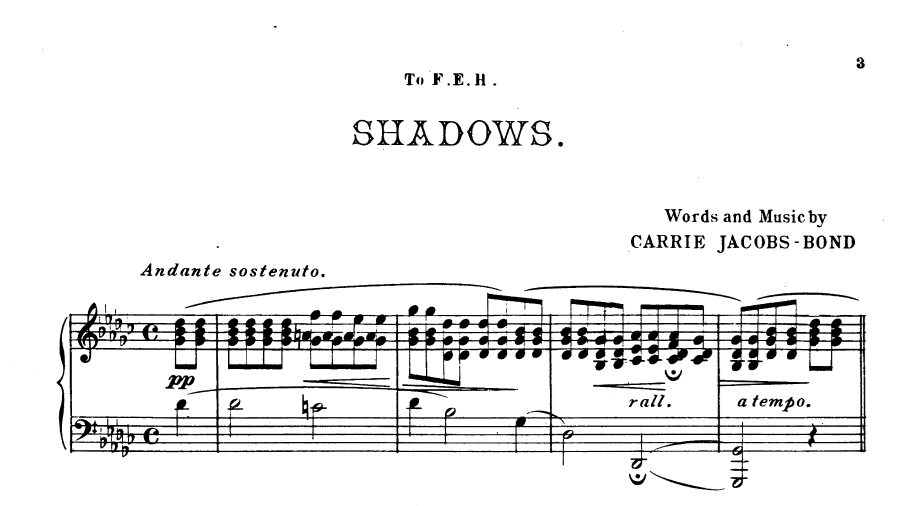
Jacobs-Bond’s last known performance of “Alone” occurred just as she and others first began to perform songs that would eventually appear in 1901 in Seven Songs as Unpretentious as the Wild Rose. By September 1899 Lillian Russell had taken up “I Love You Truly;” Carrie had started to program her setting of Paul Laurence Dunbar’s “De Las’ Long Res’;” and most significantly, she had also sung “Shadows,” the song that she positioned prominently as first of the Seven Songs, privately for an important new friend.
“Shadows” is, I think, a reincarnation of “Alone,” preserving the music and a newly conceived, shorter, and emotionally more evocative version of the sentiments. The two poems convey similar messages, though the later one does so with deeper layers of imagery. Instead of beginning with the widow looking pensively over the ocean, “Shadows” describes a scene many more people had experienced themselves: that of an evening spent watching embers glow in a fireplace.
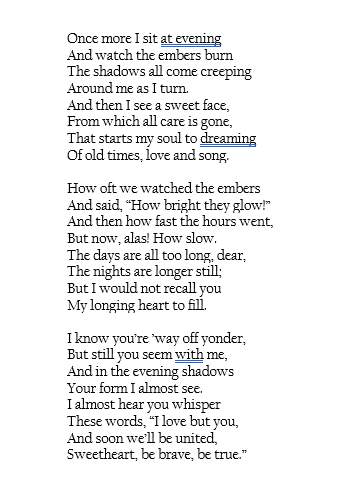
A few of the lines are thinly veiled rewrites, as when verses 5 and 6 in “Alone” – “And I am a child again, With a life all free from care” – become “And then I see a sweet face From which all care is gone.” The rewrite demonstrates the extent to which Carrie had made strides as a poet, replacing mere description – “I think of the past, my sweetheart, Just of the past, with you” – with verses that have emotional depth: “The shadows all come creeping, / Around me as I turn.”
For the possibility that some of the music she composed for “Alone” survives in “Shadows,” the poems have one crucial element in common: the poetic feet and meters of both are the same, iambic trimeters. The music of “Shadows” could easily have served the verses of “Alone,” albeit extended in some way to account for the lengthier stanzas. Fortunately there is a good recording of this largely unknown Jacobs-Bond song.
Her young and influential friend Victor Sincere, a recent graduate of the University of Chicago, remembers meeting Carrie for the first time in the late 1890s, most probably in March or April, 1899. He had scheduled a visit with Carrie’s neighbor in her East 31st Street apartment house. The neighbor, unexpectedly needing to attend to another matter, asked Carrie to entertain her visitor until she returned, a request she happily obliged. Because he was a singer, this visit inevitably led to her performing her latest songs for him. “Shadows” moved him to tears, tears he hid by walking over to stare out the window. He recalled later that she intended to dedicate it to her husband Frank.
Among the signs that this song held special importance for Carrie: she paired it in performances over the years either with “I Love You Truly,” or later in a set that included “A Perfect Day” and “Just a-Wearyin’ for You;” she positioned “Shadows” as the lead song in her set of Seven Songs; it is one of three songs in the set dedicated to people who had earned a special spot in her heart, “I Love You Truly” to “A. B. H.” (Anne B. Howe, a close friend in Marshalltown, Iowa), “Just a-Wearyin’ for You” to “F. B.” (Frank Bond), and “Shadows” to “F. E. H.”
Most probably these initials stand for Elbert Hubbard, then commonly known as Fra Elbertus Hubbard. A prominent leader of the Arts and Crafts movement in the United States, a disciple of William Morris, editor of The Philistine – A Periodical of Protest, author of the best-seller A Message to Garcia, and founder of the Roycroft community, Hubbard was then Carrie Jacobs-Bond’s most important nationally known supporter. He had a fundamental influence on her artistic growth and commercial goals. If Jacobs-Bond acknowledged Hubbard cryptically as the dedicatee of “Shadows,” on the very last page of Seven Songs she placed the testimonial for her that Hubbard had just published in the January 1901 edition of The Philistine, an issue that had appeared already in December:
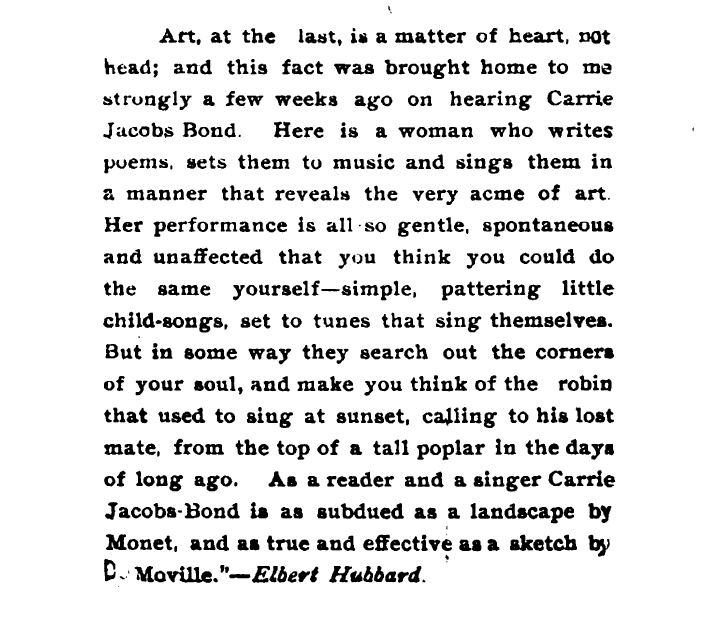
(The last artist is presumably Louis-Maurice Boutet de Monvel, illustrator of children’s books, praised for combing simplicity and naivete with artistic depth, exactly the traits he lauded in Carrie. Boutet de Monvel was then at the height of his American popularity.)
In the two decades after Carrie wrote “Shadows,” she included it in recital after recital. Years later she also described this song as her first composition. If it was indeed a rewrite of “Alone,” newly constructed and presented as the lead song in a collection that launched her career, then that claim is actually justified. “Shadows” deserves to be revived.
Notes
Holly Leaves, 11/41 (20 Oct. 1922): 10.
Jacobs-Bond, “Music Composition as a Field for Women,” The Etude, 38/9 (Sept. 1920): 583.
The Chicago review of “Alone” appeared in The Musical Critic, 1/3 (Dec., 1897): 9 – “Chicago, Dec. 21st, 1897, [… ] of the vocal numbers, ‘Pansy and Forget-me-not,’ ‘Alone’ and ‘When Do I Want You Most?’ are especially tuneful.”
W. W. Denslow’s cover for “Alone” and the poem appeared in The Bill Poster 2/5 (June 1897): 15-16.
Jacobs-Bond described meeting Victor Sincere in her autobiography, The Roads of Melody (New York: D. Appleton & Co., 1927): 47-48. She recalls singing “I Love You Truly” for him. Victor Sincere wrote a speech about Carrie, probably for her 82nd birthday celebration in August 1944, in which he recalls her singing “Shadows.” I consulted the copy in the Iron County Historical & Museum Society in Iron River, MI, in March 2020.
Jacobs-Bond referred to “Shadows” as her first published song in a performance in Oakland, CA, on 7 April 1910; reported in the Evening Times-Star and Alameda Daily Argus (9 April 1910).